Pearson+ LogoPearson+ Logo
Ch. 26 Hormones and the Endocrine System
Taylor - Campbell Biology: Concepts & Connections 10th Edition
Taylor, Simon, Dickey, Hogan10th EditionCampbell Biology: Concepts & ConnectionsISBN: 9780136538783Not the one you use?Change textbook
Chapter 26, Problem 7

If a person has a pituitary tumor that is oversecreting TSH, would this person be likely to have goiter as a symptom? Explain.

Verified step by step guidance
1
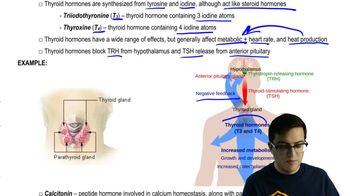
Understand the role of TSH: TSH, or Thyroid Stimulating Hormone, is produced by the pituitary gland and plays a crucial role in regulating the thyroid gland's production of thyroid hormones (thyroxine T4 and triiodothyronine T3).
Recognize the feedback loop: Normally, the levels of T4 and T3 in the blood regulate the production of TSH through a negative feedback mechanism. High levels of thyroid hormones inhibit the production of TSH, maintaining hormone balance.
Identify the effect of a pituitary tumor: A pituitary tumor that oversecretes TSH disrupts this feedback mechanism. The tumor continuously produces high levels of TSH regardless of the thyroid hormone levels in the blood.
Link TSH levels to thyroid gland activity: The excessive TSH stimulates the thyroid gland to produce more thyroid hormones. This constant stimulation can cause the thyroid gland to enlarge, a condition known as goiter.
Conclude the likelihood of goiter: Given the continuous overstimulation of the thyroid gland by high levels of TSH due to the tumor, it is highly likely that the person would develop goiter as a symptom.

Verified video answer for a similar problem:

This video solution was recommended by our tutors as helpful for the problem above.
Video duration:
1m
Was this helpful?

Key Concepts

Here are the essential concepts you must grasp in order to answer the question correctly.

Thyroid-Stimulating Hormone (TSH)

TSH is a hormone produced by the pituitary gland that stimulates the thyroid gland to produce thyroid hormones (T3 and T4). An oversecretion of TSH can lead to excessive stimulation of the thyroid, causing it to enlarge, which may result in a goiter. Understanding the role of TSH is crucial for linking pituitary function to thyroid health.
Recommended video:
Guided course
04:39
Thyroid and Parathyroid Glands

Goiter

A goiter is an enlargement of the thyroid gland, which can occur due to various factors, including hormonal imbalances, iodine deficiency, or autoimmune diseases. In the context of TSH oversecretion, the thyroid gland responds to the excess TSH by growing larger, leading to the development of a goiter. Recognizing the relationship between TSH levels and thyroid size is essential for understanding this symptom.

Feedback Mechanism in Endocrine System

The endocrine system operates on feedback mechanisms, primarily negative feedback, to regulate hormone levels. In a healthy system, high levels of thyroid hormones would inhibit TSH production. However, a pituitary tumor can disrupt this balance, leading to continued TSH production despite high thyroid hormone levels, which can exacerbate conditions like goiter. Understanding this feedback loop is vital for grasping the implications of hormonal imbalances.
Recommended video:
Guided course
05:55
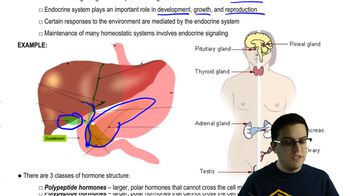
Endocrine System
Related Practice
Textbook Question
Explain how the hypothalamus controls body functions through its action on the pituitary gland. How does control of the anterior and posterior pituitary differ?
1543
views
Textbook Question
List three ways endocrine glands are stimulated to release hormones.
1995
views
Textbook Question
In a glucose tolerance test, periodic measurements of blood glucose level are taken after a person drinks a glucose-rich solution. Using the hypothetical graph below, compare and contrast the results of the test for the diabetic and the healthy individual.

1792
views
Textbook Question

Which two of the hormones listed below act upon the body with similar functions? Explain.

a. Glucagon

b. Oxytocin

c. Glucocorticoids

d. ADH

1305
views
Textbook Question

A strain of mice remains healthy as long as they are fed regularly. After they eat, their blood glucose level rises slightly and then declines to a homeostatic level. However, when these mice fast or exercise, their blood glucose drops dangerously. Which hypothesis best explains their problem? (Explain your choice.)

a. The mice have insulin-dependent diabetes.

b. The mice lack insulin receptors on their cells.

c. The mice lack glucagon receptors on their cells.

d. The mice cannot synthesize glycogen from glucose.

934
views
Textbook Question

The results of Tyrone Hayes's experiments (Module 26.3) were published in a top peer-reviewed journal, yet the validity of his experiments has since been challenged. Using external sources, find out who has challenged the results.

821
views