
Pearson+ LogoPearson+ Logo
Ch. 11 How Genes Are Controlled
Taylor - Campbell Biology: Concepts & Connections 10th Edition
Taylor, Simon, Dickey, Hogan10th EditionCampbell Biology: Concepts & ConnectionsISBN: 9780136538783Not the one you use?Change textbook
Chapter 11, Problem 12

The success of an experiment often depends on choosing an appropriate organism to study. For example, Gregor Mendel was able to deduce the fundamental principles in genetics in part because of his choice of the pea plant. Reviewing Module 10.1, how did Hershey and Chase take advantage of the unique structural properties of bacteriophage T2 to determine the genetic material?

Verified step by step guidance
1
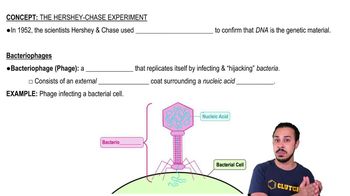
Review the structure of bacteriophage T2: Bacteriophage T2 is a virus that infects bacteria. It consists of a protein coat (capsid) and DNA inside the capsid. This structural simplicity makes it an ideal organism for studying the genetic material, as it has only two main components to analyze: protein and DNA.
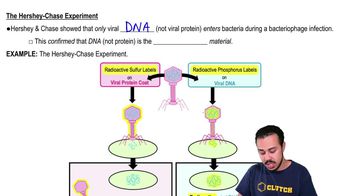
Understand the experimental design: Hershey and Chase used radioactive isotopes to label the two components of the bacteriophage. They labeled the DNA with radioactive phosphorus-32 (32P), since DNA contains phosphorus but no sulfur. They labeled the protein coat with radioactive sulfur-35 (35S), since proteins contain sulfur but no phosphorus.
Describe the infection process: The bacteriophage attaches to a bacterial cell and injects its genetic material into the host. The protein coat remains outside the bacterial cell, while the genetic material enters the cell to direct the production of new viruses.
Explain the separation of components: After allowing the bacteriophages to infect the bacteria, Hershey and Chase used a blender to separate the phage protein coats from the bacterial cells. They then used a centrifuge to isolate the bacterial cells from the rest of the mixture.
Analyze the results: They measured the radioactivity in the bacterial cells and the surrounding solution. They found that the radioactive phosphorus (32P) was inside the bacterial cells, indicating that DNA was the genetic material injected by the phage. The radioactive sulfur (35S) remained in the solution, showing that the protein coat did not enter the bacterial cells.

Verified video answer for a similar problem:

This video solution was recommended by our tutors as helpful for the problem above.
Video duration:
41s
Was this helpful?

Key Concepts

Here are the essential concepts you must grasp in order to answer the question correctly.

Bacteriophage Structure

Bacteriophages, or phages, are viruses that specifically infect bacteria. The T2 bacteriophage consists of a protein coat (capsid) and a DNA core. This simple structure allows researchers to study the role of DNA in heredity, as the phage injects its genetic material into the host bacterium, leading to the production of new phages.
Recommended video:
Guided course
03:44
Bacteriophages

Hershey-Chase Experiment

The Hershey-Chase experiment, conducted in 1952, utilized T2 bacteriophages to determine whether DNA or protein was the genetic material. By labeling the DNA with radioactive phosphorus and the protein with sulfur, they tracked which component entered the bacterial cells. The results showed that only the DNA entered the cells, confirming that DNA is the genetic material.
Recommended video:
Guided course
03:59
The Hershey-Chase Experiment

Genetic Material

Genetic material refers to the molecules that carry the genetic instructions for the development, functioning, growth, and reproduction of all known organisms and many viruses. In most organisms, this material is DNA, which encodes the information necessary for building proteins and regulating cellular activities. The identification of DNA as the genetic material was a pivotal moment in molecular biology.
Recommended video:
Related Practice
Textbook Question

You obtain an egg cell from the ovary of a white mouse and remove the nucleus from it. You then obtain a nucleus from a liver cell from an adult black mouse. You use the methods of nuclear transplantation to insert the nucleus into the empty egg. After some prompting, the new zygote divides into an early embryo, which you then implant into the uterus of a brown mouse. A few weeks later, a baby mouse is born. What color will it be? Why?

988
views
Textbook Question

Mutations can alter the function of the lac operon (see Module 11.1). Predict how the following mutations would affect the function of the operon in the presence and absence of lactose:

a. Mutation of the regulatory gene; repressor cannot bind to lactose.

b. Mutation of operator; repressor will not bind to operator.

c. Mutation of regulatory gene; repressor will not bind to operator.

d. Mutation of promoter; RNA polymerase will not attach to promoter.

2514
views
Textbook Question

It took three sheep to create the clone Dolly: A blackface sheep donated the egg, a whiteface sheep donated the mammary cells from which the nucleus was taken, and a blackface sheep served as surrogate. Assuming face color is genetically determined, what color face did Dolly have?

1408
views
Textbook Question

Each scientist works as part of a broader community of scientists, building on the work of others. Scientific advances often depend on the application of new technologies and/or on new techniques applied to an existing problem.

What improvements to existing cloning methods did Wilmut make that allowed him to successfully clone Dolly the sheep from an adult cell?

1184
views
Textbook Question
Scientific Thinking The study described in Module 8.10 was purely observational; there were no controlled groups. Imagine that you are an oncologist. Design a hypothesis-driven study to determine whether mastectomy improves breast cancer survival over lumpectomy. What are your control groups? Would such a study be ethical to undertake? Why or why not?
1450
views