
Pearson+ LogoPearson+ Logo
Ch. 11 How Genes Are Controlled
Taylor - Campbell Biology: Concepts & Connections 10th Edition
Taylor, Simon, Dickey, Hogan10th EditionCampbell Biology: Concepts & ConnectionsISBN: 9780136538783Not the one you use?Change textbook
Chapter 11, Problem 9

Mutations can alter the function of the lac operon (see Module 11.1). Predict how the following mutations would affect the function of the operon in the presence and absence of lactose:
a. Mutation of the regulatory gene; repressor cannot bind to lactose.
b. Mutation of operator; repressor will not bind to operator.
c. Mutation of regulatory gene; repressor will not bind to operator.
d. Mutation of promoter; RNA polymerase will not attach to promoter.

Verified step by step guidance
1
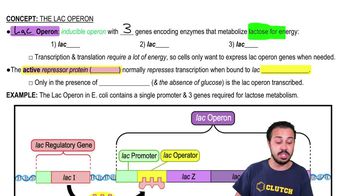
Step 1: Understand the lac operon system. The lac operon is a group of genes in prokaryotes (like E. coli) that are involved in lactose metabolism. It includes structural genes (lacZ, lacY, lacA), a promoter (where RNA polymerase binds), an operator (where the repressor binds), and a regulatory gene (which produces the repressor protein). The operon is regulated by the presence or absence of lactose and the ability of the repressor to bind to the operator or lactose.
Step 2: Analyze mutation (a): Mutation of the regulatory gene; repressor cannot bind to lactose. If the repressor cannot bind to lactose, it will remain bound to the operator even in the presence of lactose. This would prevent RNA polymerase from transcribing the structural genes, meaning the operon would remain off regardless of lactose presence.
Step 3: Analyze mutation (b): Mutation of the operator; repressor will not bind to the operator. If the repressor cannot bind to the operator, the operon will remain on regardless of lactose presence. RNA polymerase will continuously transcribe the structural genes, leading to constant production of enzymes for lactose metabolism, even when lactose is absent.
Step 4: Analyze mutation (c): Mutation of the regulatory gene; repressor will not bind to the operator. If the repressor cannot bind to the operator, it is similar to mutation (b). The operon will remain on, and RNA polymerase will continuously transcribe the structural genes, leading to constant enzyme production regardless of lactose presence.
Step 5: Analyze mutation (d): Mutation of the promoter; RNA polymerase will not attach to the promoter. If RNA polymerase cannot bind to the promoter, transcription of the structural genes will not occur. This means the operon will remain off, and the enzymes for lactose metabolism will not be produced, regardless of lactose presence.

Verified video answer for a similar problem:

This video solution was recommended by our tutors as helpful for the problem above.
Video duration:
51s
Was this helpful?

Key Concepts

Here are the essential concepts you must grasp in order to answer the question correctly.

Lac Operon Structure and Function

The lac operon is a set of genes in E. coli that are involved in the metabolism of lactose. It consists of structural genes (lacZ, lacY, and lacA), a promoter, an operator, and regulatory genes. The operon is regulated by the presence of lactose, which binds to the repressor protein, allowing transcription of the genes necessary for lactose utilization when lactose is available.
Recommended video:
Guided course
07:06
The Lac Operon

Repressor Protein and Its Role

The repressor protein is a key regulatory element in the lac operon that binds to the operator region to inhibit transcription. In the absence of lactose, the repressor binds to the operator, preventing RNA polymerase from transcribing the operon. When lactose is present, it binds to the repressor, causing a conformational change that releases the repressor from the operator, allowing gene expression.
Recommended video:

Mutations and Their Effects on Gene Regulation

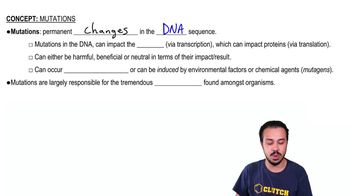
Mutations in the lac operon can significantly impact its regulation and function. For example, mutations in the regulatory gene can affect the repressor's ability to bind to lactose or the operator, while mutations in the promoter can hinder RNA polymerase's ability to initiate transcription. Understanding these mutations helps predict how the operon will respond to the presence or absence of lactose.
Recommended video:
Related Practice
Textbook Question

Your bone cells, muscle cells, and skin cells look different because

a. Each cell contains different kinds of genes.

b. They are present in different organs.

c. Different genes are active in each kind of cell.

d. They contain different numbers of genes.

1769
views
Textbook Question

All your cells contain proto-oncogenes, which can change into cancer-causing oncogenes. Why do cells possess such potential time bombs?

1781
views
Textbook Question

You obtain an egg cell from the ovary of a white mouse and remove the nucleus from it. You then obtain a nucleus from a liver cell from an adult black mouse. You use the methods of nuclear transplantation to insert the nucleus into the empty egg. After some prompting, the new zygote divides into an early embryo, which you then implant into the uterus of a brown mouse. A few weeks later, a baby mouse is born. What color will it be? Why?

988
views
Textbook Question

It took three sheep to create the clone Dolly: A blackface sheep donated the egg, a whiteface sheep donated the mammary cells from which the nucleus was taken, and a blackface sheep served as surrogate. Assuming face color is genetically determined, what color face did Dolly have?

1408
views
Textbook Question

The success of an experiment often depends on choosing an appropriate organism to study. For example, Gregor Mendel was able to deduce the fundamental principles in genetics in part because of his choice of the pea plant. Reviewing Module 10.1, how did Hershey and Chase take advantage of the unique structural properties of bacteriophage T2 to determine the genetic material?

1094
views
Textbook Question

Each scientist works as part of a broader community of scientists, building on the work of others. Scientific advances often depend on the application of new technologies and/or on new techniques applied to an existing problem.

What improvements to existing cloning methods did Wilmut make that allowed him to successfully clone Dolly the sheep from an adult cell?

1184
views