Pearson+ LogoPearson+ Logo
Ch. 13 How Populations Evolve
Taylor - Campbell Biology: Concepts & Connections 10th Edition
Taylor, Simon, Dickey, Hogan10th EditionCampbell Biology: Concepts & ConnectionsISBN: 9780136538783Not the one you use?Change textbook
Chapter 13, Problem 2

Complete this concept map describing potential causes of evolutionary change within populations.
Concept map illustrating causes of evolutionary change in populations for biology chapter on evolution.

Verified step by step guidance
1
Step 1: Begin by identifying the overarching concept of microevolution, which is defined as the change in allele frequencies within a population over time. This concept map explores the causes of such changes.
Step 2: For box (a), consider the process of genetic drift, which refers to random fluctuations in allele frequencies. These fluctuations are more pronounced in small populations, as indicated in box (d).
Step 3: For box (b), focus on gene flow, which occurs due to the movement of individuals or gametes between populations. This movement introduces new alleles and can alter allele frequencies.
Step 4: For box (c), examine natural selection, which is depicted in the image showing a shift in the distribution curve. Natural selection occurs due to differential survival and reproduction of individuals based on their traits, leading to adaptive evolution.
Step 5: For boxes (e) and (f), explore the bottleneck effect and founder effect, respectively. These are specific instances of genetic drift. The bottleneck effect occurs when a population undergoes a drastic reduction in size, while the founder effect happens when a small group establishes a new population, leading to reduced genetic variation.

Verified video answer for a similar problem:

This video solution was recommended by our tutors as helpful for the problem above.
Video duration:
1m
Was this helpful?

Key Concepts

Here are the essential concepts you must grasp in order to answer the question correctly.

Microevolution

Microevolution refers to small-scale evolutionary changes that occur within a population, primarily through alterations in allele frequencies over time. These changes can result from various mechanisms such as natural selection, genetic drift, mutation, and gene flow. Understanding microevolution is crucial for grasping how populations adapt to their environments and how species evolve over generations.
Recommended video:
03:03
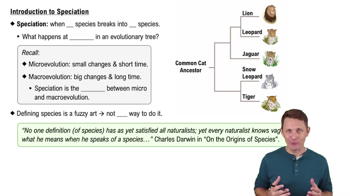
Introduction to Speciation

Genetic Drift

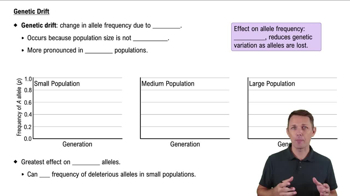
Genetic drift is a mechanism of evolution that involves random fluctuations in allele frequencies within a population, particularly in small populations. This randomness can lead to significant changes in genetic diversity over time, as certain alleles may become more or less common purely by chance. It highlights the role of chance events in shaping the genetic structure of populations.
Recommended video:
05:06
Genetic Drift

Natural Selection

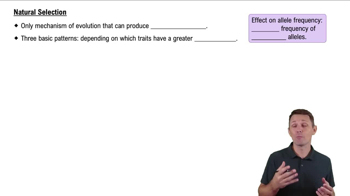
Natural selection is a fundamental mechanism of evolution where individuals with traits better suited to their environment tend to survive and reproduce more successfully than others. This process leads to adaptive evolution, where advantageous traits become more common in the population over generations. Understanding natural selection is essential for explaining how species adapt to changing environments and the emergence of new traits.
Recommended video:
04:43
Natural Selection