

Pearson+ LogoPearson+ Logo
Ch. 13 How Populations Evolve
Taylor - Campbell Biology: Concepts & Connections 10th Edition
Taylor, Simon, Dickey, Hogan10th EditionCampbell Biology: Concepts & ConnectionsISBN: 9780136538783Not the one you use?Change textbook
Chapter 13, Problem 9

In the late 1700s, machines that could blast through rock to build roads and railways were invented, exposing deep layers of rocks. How would you expect this development to aid the science of paleontology?

Verified step by step guidance
1
Understand the connection between rock layers and fossils: Fossils are typically found embedded in sedimentary rock layers. These layers provide a record of Earth's history, including the organisms that lived during specific time periods.
Recognize the significance of deeper rock layers: Deeper layers of rock correspond to older geological time periods. By accessing these layers, scientists can study fossils from earlier eras, providing insights into the evolution of life on Earth.
Consider how blasting technology aids fossil discovery: Machines capable of blasting through rock allow paleontologists to access previously unreachable layers of rock, increasing the likelihood of discovering new fossils and expanding the fossil record.
Acknowledge the role of stratigraphy: Stratigraphy, the study of rock layers, helps paleontologists determine the relative ages of fossils. Access to deeper layers enhances the ability to construct a more detailed timeline of Earth's biological history.
Reflect on the broader impact on paleontology: The development of such machines likely accelerated the pace of fossil discovery, leading to new species identification, better understanding of extinction events, and insights into evolutionary patterns.

Verified video answer for a similar problem:

This video solution was recommended by our tutors as helpful for the problem above.
Video duration:
2m
Was this helpful?

Key Concepts

Here are the essential concepts you must grasp in order to answer the question correctly.

Stratigraphy

Stratigraphy is the study of rock layers (strata) and layering (stratification). It is crucial in paleontology as it helps scientists understand the chronological sequence of geological events and the relative ages of fossils found within different layers. By exposing deeper rock layers, the invention of machines allowed paleontologists to access older strata, providing insights into the history of life on Earth.

Fossilization

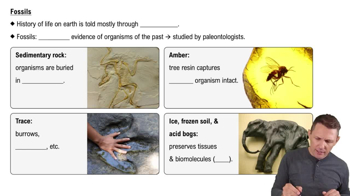
Fossilization is the process through which organic material is preserved in sedimentary rock over geological time. This process can occur through various mechanisms, such as permineralization or cast formation. The ability to access deeper layers of rock means that paleontologists can discover older fossils, which can reveal information about extinct species and their environments.
Recommended video:
03:54
Fossils

Geological Time Scale

The Geological Time Scale is a system that categorizes Earth's history into different time intervals, such as eons, eras, periods, and epochs. This framework allows scientists to place fossils and geological events in a temporal context. The exposure of deeper rock layers through machinery would provide a more comprehensive view of the geological time scale, aiding in the understanding of evolutionary processes and the history of life on Earth.
Recommended video:
Related Practice
Textbook Question

If an allele is recessive and lethal in homozygotes before they reproduce,

a. The allele will be removed from the population by natural selection in approximately 1,000 years.

b. The allele will likely remain in the population at a low frequency because it cannot be selected against in heterozygotes.

c. The fitness of the homozygous recessive genotype is 0.

d. Both b and c are correct.

2242
views
Textbook Question

In a population with two alleles, B and b, the allele frequency of b is 0.4. B is dominant to b. What is the frequency of individuals with the dominant phenotype if the population is in Hardy-Weinberg equilibrium?

a. 0.16

b. 0.36

c. 0.48

d. 0.84

2037
views
Textbook Question

Within a few weeks of treatment with the drug 3TC, a patient's HIV population consists entirely of 3TC-resistant viruses. How can this result best be explained?

a. HIV can change its surface proteins and resist vaccines.

b. The patient must have become reinfected with a resistant virus.

c. A few drug-resistant viruses were present at the start of treatment, and natural selection increased their frequency.

d. HIV began making drug-resistant versions of its enzymes in response to the drug.

1077
views
Textbook Question

Write a paragraph briefly describing the kinds of scientific evidence for evolution.

828
views
Textbook Question

In the early 1800s, French naturalist Jean Baptiste Lamarck suggested that the best explanation for the relationship of fossils to current organisms is that life evolves. He proposed that by using or not using its body parts, an individual may change its traits and then pass those changes on to its offspring. He suggested, for instance, that the ancestors of the giraffe had lengthened their necks by stretching higher and higher into the trees to reach leaves. Evaluate Lamarck's hypotheses from the perspective of present-day scientific knowledge.

1207
views
Textbook Question

Sickle-cell disease is caused by a recessive allele. Roughly one out of every 400 African Americans (0.25%) is afflicted with sickle-cell disease. Use the Hardy-Weinberg equation to calculate the percentage of African Americans who are carriers of the sickle-cell allele. (Hint: q2 = 0.0025.)

2125
views
1
rank