Pearson+ LogoPearson+ Logo
Ch. 13 How Populations Evolve
Taylor - Campbell Biology: Concepts & Connections 10th Edition
Taylor, Simon, Dickey, Hogan10th EditionCampbell Biology: Concepts & ConnectionsISBN: 9780136538783Not the one you use?Change textbook
Chapter 13, Problem 11

In the early 1800s, French naturalist Jean Baptiste Lamarck suggested that the best explanation for the relationship of fossils to current organisms is that life evolves. He proposed that by using or not using its body parts, an individual may change its traits and then pass those changes on to its offspring. He suggested, for instance, that the ancestors of the giraffe had lengthened their necks by stretching higher and higher into the trees to reach leaves. Evaluate Lamarck's hypotheses from the perspective of present-day scientific knowledge.

Verified step by step guidance
1
Understand Lamarck's hypothesis: Lamarck proposed the idea of inheritance of acquired characteristics, suggesting that traits developed during an organism's lifetime due to use or disuse could be passed on to its offspring. For example, he believed giraffes stretched their necks to reach higher leaves, and this trait was inherited by their descendants.
Compare Lamarck's hypothesis to modern evolutionary theory: Present-day scientific knowledge, based on Darwin's theory of natural selection, explains evolution as a process driven by genetic variation and differential survival and reproduction. Traits are passed through genetic inheritance, not acquired characteristics.
Consider the role of genetics: Modern genetics shows that traits are encoded in DNA and changes in traits occur due to mutations, genetic recombination, and environmental pressures. Acquired traits, such as a giraffe stretching its neck, do not alter the DNA and therefore cannot be inherited.
Evaluate experimental evidence: Studies in genetics and evolutionary biology have demonstrated that acquired traits are not passed to offspring. For example, experiments with animals that undergo physical changes during their lifetime (e.g., muscle growth due to exercise) show that these changes do not affect the genetic material passed to their offspring.
Summarize the scientific consensus: Lamarck's hypothesis is not supported by modern scientific evidence. Evolution occurs through genetic changes over generations, influenced by natural selection, rather than the inheritance of traits acquired during an organism's lifetime.

Verified video answer for a similar problem:

This video solution was recommended by our tutors as helpful for the problem above.
Video duration:
3m
Was this helpful?

Key Concepts

Here are the essential concepts you must grasp in order to answer the question correctly.

Lamarckism

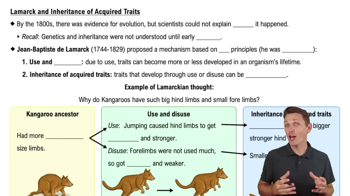
Lamarckism is the early evolutionary theory proposed by Jean Baptiste Lamarck, which posits that organisms can acquire traits during their lifetime based on their use or disuse of body parts. For example, he suggested that giraffes developed longer necks because their ancestors stretched to reach higher leaves, and these acquired traits could be inherited by their offspring. This concept contrasts with modern evolutionary theory, which emphasizes genetic inheritance rather than acquired characteristics.
Recommended video:
04:39
Lamarck and Inheritance of Acquired Traits

Natural Selection

Natural selection is a fundamental mechanism of evolution, first articulated by Charles Darwin. It describes the process by which individuals with advantageous traits are more likely to survive and reproduce, thereby passing those traits to the next generation. Unlike Lamarck's ideas, natural selection relies on existing genetic variation within a population, leading to gradual changes over time rather than the inheritance of acquired characteristics.
Recommended video:
04:43
Natural Selection

Modern Genetics

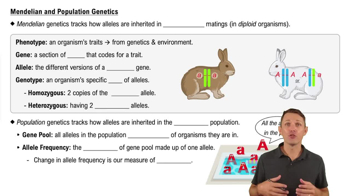
Modern genetics provides a molecular basis for understanding heredity and variation in organisms. It reveals that traits are passed down through genes, which are segments of DNA. This understanding contradicts Lamarck's hypothesis, as it shows that changes in traits occur through mutations and genetic recombination rather than through the direct influence of an organism's behavior or environment during its lifetime.
Recommended video:
04:26
Mendelian and Population Genetics
Related Practice
Textbook Question

Within a few weeks of treatment with the drug 3TC, a patient's HIV population consists entirely of 3TC-resistant viruses. How can this result best be explained?

a. HIV can change its surface proteins and resist vaccines.

b. The patient must have become reinfected with a resistant virus.

c. A few drug-resistant viruses were present at the start of treatment, and natural selection increased their frequency.

d. HIV began making drug-resistant versions of its enzymes in response to the drug.

1077
views
Textbook Question

In the late 1700s, machines that could blast through rock to build roads and railways were invented, exposing deep layers of rocks. How would you expect this development to aid the science of paleontology?

965
views
Textbook Question

Write a paragraph briefly describing the kinds of scientific evidence for evolution.

828
views
Textbook Question

Sickle-cell disease is caused by a recessive allele. Roughly one out of every 400 African Americans (0.25%) is afflicted with sickle-cell disease. Use the Hardy-Weinberg equation to calculate the percentage of African Americans who are carriers of the sickle-cell allele. (Hint: q2 = 0.0025.)

2125
views
1
rank
Textbook Question
It seems logical that natural selection would work toward genetic uniformity; the genotypes that are most fit produce the most offspring, increasing the frequency of adaptive alleles and eliminating less adaptive alleles. Yet there remains a great deal of genetic variation within populations. Describe factors that contribute to this variation.
1314
views
Textbook Question

Cetaceans are fully aquatic mammals that evolved from terrestrial ancestors. Gather information about the respiratory system of cetaceans and describe how it illustrates the statement made in that 'Evolution is limited by historical constraints.'

946
views