
Pearson+ LogoPearson+ Logo
Ch. 13 How Populations Evolve
Taylor - Campbell Biology: Concepts & Connections 10th Edition
Taylor, Simon, Dickey, Hogan10th EditionCampbell Biology: Concepts & ConnectionsISBN: 9780136538783Not the one you use?Change textbook
Chapter 13, Problem 7

In a population with two alleles, B and b, the allele frequency of b is 0.4. B is dominant to b. What is the frequency of individuals with the dominant phenotype if the population is in Hardy-Weinberg equilibrium?
a. 0.16
b. 0.36
c. 0.48
d. 0.84

Verified step by step guidance
1
Step 1: Recall the Hardy-Weinberg equilibrium principle, which states that the sum of allele frequencies in a population is 1. Let p represent the frequency of the dominant allele (B) and q represent the frequency of the recessive allele (b). Since the frequency of b (q) is given as 0.4, calculate p using the equation p + q = 1. Solve for p: p = 1 - q.
Step 2: Use the Hardy-Weinberg equation to calculate genotype frequencies. The equation is: \( p^2 + 2pq + q^2 = 1 \), where \( p^2 \) represents the frequency of homozygous dominant individuals (BB), \( 2pq \) represents the frequency of heterozygous individuals (Bb), and \( q^2 \) represents the frequency of homozygous recessive individuals (bb).
Step 3: Calculate \( p^2 \), the frequency of homozygous dominant individuals, by squaring the value of p obtained in Step 1: \( p^2 = p \times p \).
Step 4: Calculate \( 2pq \), the frequency of heterozygous individuals, by multiplying 2, p, and q: \( 2pq = 2 \times p \times q \).
Step 5: Add the frequencies of homozygous dominant (\( p^2 \)) and heterozygous (\( 2pq \)) individuals to determine the total frequency of individuals with the dominant phenotype. This is because both BB and Bb individuals express the dominant phenotype. The final expression is: \( p^2 + 2pq \).

Verified video answer for a similar problem:

This video solution was recommended by our tutors as helpful for the problem above.
Video duration:
1m
Was this helpful?

Key Concepts

Here are the essential concepts you must grasp in order to answer the question correctly.

Hardy-Weinberg Equilibrium

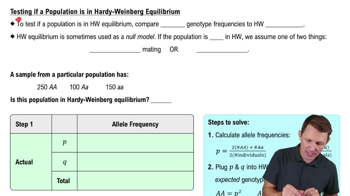
Hardy-Weinberg equilibrium is a principle that describes a population that is not evolving. It states that allele and genotype frequencies will remain constant from generation to generation in the absence of evolutionary influences. For a population to be in Hardy-Weinberg equilibrium, certain conditions must be met, including no mutations, random mating, no natural selection, large population size, and no gene flow.
Recommended video:
08:26
Testing if a Population is in Hardy-Weinberg Equilibrium

Allele Frequency

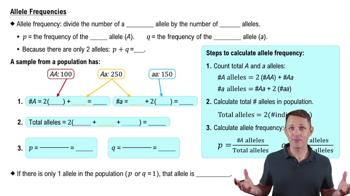
Allele frequency refers to how often a particular allele appears in a population compared to other alleles for the same gene. In this case, the frequency of allele b is given as 0.4, which means that 40% of the alleles in the population are b. The frequency of the dominant allele B can be calculated as 1 - frequency of b, which is 0.6.
Recommended video:
06:36
Allele Frequencies

Phenotype Frequency

Phenotype frequency is the proportion of individuals in a population that exhibit a particular phenotype, which is the observable trait resulting from the genotype. In this scenario, since B is dominant over b, both BB and Bb genotypes will display the dominant phenotype. The frequency of individuals with the dominant phenotype can be calculated using the Hardy-Weinberg formula, which incorporates the allele frequencies.
Recommended video:
06:36
Allele Frequencies
Related Practice
Textbook Question

Natural selection is sometimes described as 'survival of the fittest.' Which of the following best measures an organism's fitness?

a. How many fertile offspring it produces

b. How strong it is when pitted against others of its species

c. Its ability to withstand environmental extremes

d. How much food it is able to make or obtain

2744
views
Textbook Question

In an area of erratic rainfall, a biologist found that grass plants with alleles for curled leaves reproduced better in dry years, and plants with alleles for flat leaves reproduced better in wet years. This situation would tend to _________ . (Explain your answer.)

a. Cause genetic drift in the grass population.

b. Preserve genetic variation in the grass population.

c. Lead to stabilizing selection in the grass population.

d. Lead to uniformity in the grass population.

884
views
Textbook Question

If an allele is recessive and lethal in homozygotes before they reproduce,

a. The allele will be removed from the population by natural selection in approximately 1,000 years.

b. The allele will likely remain in the population at a low frequency because it cannot be selected against in heterozygotes.

c. The fitness of the homozygous recessive genotype is 0.

d. Both b and c are correct.

2242
views
Textbook Question

Within a few weeks of treatment with the drug 3TC, a patient's HIV population consists entirely of 3TC-resistant viruses. How can this result best be explained?

a. HIV can change its surface proteins and resist vaccines.

b. The patient must have become reinfected with a resistant virus.

c. A few drug-resistant viruses were present at the start of treatment, and natural selection increased their frequency.

d. HIV began making drug-resistant versions of its enzymes in response to the drug.

1077
views
Textbook Question

In the late 1700s, machines that could blast through rock to build roads and railways were invented, exposing deep layers of rocks. How would you expect this development to aid the science of paleontology?

965
views
Textbook Question

Write a paragraph briefly describing the kinds of scientific evidence for evolution.

828
views