Pearson+ LogoPearson+ Logo
Ch. 24 The Immune System
Taylor - Campbell Biology: Concepts & Connections 10th Edition
Taylor, Simon, Dickey, Hogan10th EditionCampbell Biology: Concepts & ConnectionsISBN: 9780136538783Not the one you use?Change textbook
Chapter 24, Problem 9

In the condition myasthenia gravis, antibodies bind to and block certain receptors on muscle cells, preventing muscle contraction. This condition is best classified as an
a. Immunodeficiency disorder.
b. Exaggerated immune reaction.
c. Allergic reaction.
d. Autoimmune disorder.

Verified step by step guidance
1
Understand the condition described: Myasthenia gravis is a condition where antibodies target and block receptors on muscle cells, interfering with normal muscle contraction.
Recall the definition of an autoimmune disorder: It occurs when the immune system mistakenly attacks the body's own cells, tissues, or organs.
Compare the condition to other immune-related disorders: Immunodeficiency disorders involve a weakened immune system, exaggerated immune reactions involve an overactive response to external threats, and allergic reactions are hypersensitive responses to harmless substances.
Identify the key feature of myasthenia gravis: The immune system produces antibodies that attack the body's own muscle cell receptors, which aligns with the definition of an autoimmune disorder.
Conclude that the condition is best classified as an autoimmune disorder based on the mechanism of action described.

Verified video answer for a similar problem:

This video solution was recommended by our tutors as helpful for the problem above.
Video duration:
49s
Was this helpful?

Key Concepts

Here are the essential concepts you must grasp in order to answer the question correctly.

Autoimmune Disorder

An autoimmune disorder occurs when the immune system mistakenly attacks the body's own cells, tissues, or organs. In the case of myasthenia gravis, the immune system produces antibodies that target acetylcholine receptors on muscle cells, disrupting normal communication between nerves and muscles, leading to muscle weakness.
Recommended video:
Guided course
07:51
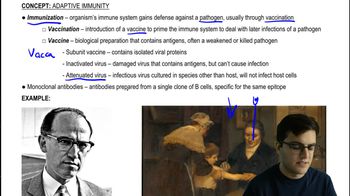
Immunization and Autoimmunity

Antibodies

Antibodies are specialized proteins produced by the immune system to identify and neutralize foreign objects like bacteria and viruses. In autoimmune disorders, these antibodies can mistakenly target the body's own cells, as seen in myasthenia gravis, where they block receptors essential for muscle contraction.
Recommended video:
Guided course
06:14
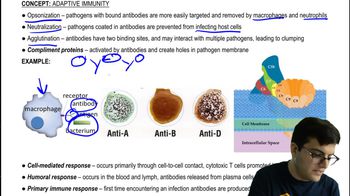
Primary and Secondary Immunity

Neuromuscular Junction

The neuromuscular junction is the synapse or connection point between a motor neuron and a muscle fiber. It is crucial for muscle contraction, as the release of neurotransmitters at this junction stimulates muscle fibers. In myasthenia gravis, the blockage of receptors at this junction impairs muscle contraction, leading to the characteristic symptoms of the disorder.
Recommended video:
Guided course
03:14
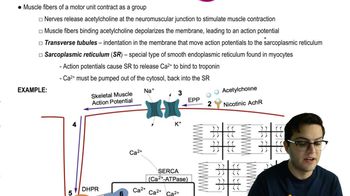
Motor Unit and Neuromuscular Junction
Related Practice
Textbook Question
Describe how HIV is transmitted and how immune system cells in an infected person are affected by HIV. What are the most effective means of preventing HIV transmission? Why is AIDS particularly deadly compared with other viral diseases?
1470
views
Textbook Question
What is inflammation? How does it protect the body? Why is inflammation considered part of the innate immune response?
1225
views
Textbook Question
Helper T cells recognize the self-nonself complex on ___________ cells, while cytotoxic T cells recognize the complex on ___________ cells.
1041
views
Textbook Question

Which of the following statements is not true?

a. An antibody has more than one antigen-binding site.

b. An antigen can have different epitopes.

c. A lymphocyte has receptors for multiple and different antigens.

d. A bacterium has more than one antigen.

1616
views
Textbook Question
Propose an explanation for why we need a flu shot year after year, instead of only once early in life.
1003
views
Textbook Question

Pertussis (whooping cough) is caused by a bacterial infection, and symptoms include an intense cough that lasts for weeks, sometimes leading to pneumonia and death. A complete vaccination against pertussis requires five doses, completed by age 5. A pertussis outbreak occurred in California in 2010, and a news article reported the following: 'Among fully immunized kids, there were about 36 cases for every 10,000 children two to seven years old, compared to 245 out of every 10,000 kids aged eight to twelve.' Propose an explanation for these data and a public health solution based on your explanation.

1009
views