
Pearson+ LogoPearson+ Logo
Ch. 24 The Immune System
Taylor - Campbell Biology: Concepts & Connections 10th Edition
Taylor, Simon, Dickey, Hogan10th EditionCampbell Biology: Concepts & ConnectionsISBN: 9780136538783Not the one you use?Change textbook
Chapter 24, Problem 12

Pertussis (whooping cough) is caused by a bacterial infection, and symptoms include an intense cough that lasts for weeks, sometimes leading to pneumonia and death. A complete vaccination against pertussis requires five doses, completed by age 5. A pertussis outbreak occurred in California in 2010, and a news article reported the following: 'Among fully immunized kids, there were about 36 cases for every 10,000 children two to seven years old, compared to 245 out of every 10,000 kids aged eight to twelve.' Propose an explanation for these data and a public health solution based on your explanation.

Verified step by step guidance
1
Understand the problem: The data shows that fully immunized children aged 2-7 had a lower incidence of pertussis (36 cases per 10,000) compared to children aged 8-12 (245 cases per 10,000). This suggests that immunity provided by the vaccine may wane over time.
Step 1: Recall the concept of vaccine-induced immunity. Vaccines stimulate the immune system to produce memory cells that recognize and fight the pathogen. However, immunity can decrease over time, which is why booster doses are sometimes necessary.
Step 2: Analyze the data. The higher incidence of pertussis in older children (8-12 years) compared to younger children (2-7 years) suggests that the immunity provided by the initial five doses of the vaccine may have diminished in the older age group.
Step 3: Propose an explanation. The waning immunity hypothesis explains the observed data. Younger children are closer to the time of their last vaccine dose, so their immunity is stronger. Older children, having received their last dose years earlier, may have reduced immunity, making them more susceptible to infection.
Step 4: Suggest a public health solution. To address waning immunity, a booster dose of the pertussis vaccine could be recommended for children aged 8-12. This would help maintain immunity and reduce the incidence of pertussis in this age group.

Verified video answer for a similar problem:

This video solution was recommended by our tutors as helpful for the problem above.
Video duration:
37s
Was this helpful?

Key Concepts

Here are the essential concepts you must grasp in order to answer the question correctly.

Vaccination and Immunity

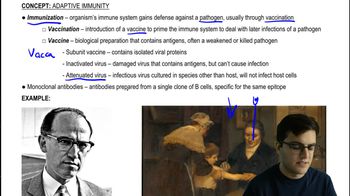
Vaccination is a method of stimulating the immune system to develop protection against specific pathogens, such as bacteria or viruses. In the case of pertussis, the vaccine helps the body recognize and fight the Bordetella pertussis bacteria. Immunity can wane over time, which may explain why older children, who received their vaccinations earlier, show higher case rates compared to younger, fully immunized children.
Recommended video:
Guided course
07:51
Immunization and Autoimmunity

Herd Immunity

Herd immunity occurs when a significant portion of a population becomes immune to a disease, either through vaccination or previous infections, thereby providing indirect protection to those who are not immune. This concept is crucial for controlling outbreaks, as higher vaccination rates can reduce the overall spread of pertussis, protecting vulnerable groups such as infants and those unable to be vaccinated.
Recommended video:
Guided course
09:19
Immune System

Public Health Interventions

Public health interventions are strategies implemented to improve health outcomes and prevent disease spread within communities. In response to the pertussis outbreak, solutions may include increasing vaccination awareness, providing booster shots for older children and adults, and implementing school vaccination requirements to ensure higher immunization rates, thereby enhancing herd immunity.
Recommended video:
04:25
Evidence of Natural Selection
Related Practice
Textbook Question

In the condition myasthenia gravis, antibodies bind to and block certain receptors on muscle cells, preventing muscle contraction. This condition is best classified as an

a. Immunodeficiency disorder.

b. Exaggerated immune reaction.

c. Allergic reaction.

d. Autoimmune disorder.

858
views
Textbook Question

Which of the following statements is not true?

a. An antibody has more than one antigen-binding site.

b. An antigen can have different epitopes.

c. A lymphocyte has receptors for multiple and different antigens.

d. A bacterium has more than one antigen.

1616
views
Textbook Question
Propose an explanation for why we need a flu shot year after year, instead of only once early in life.
1003
views
Textbook Question
Your roommate is rushed to the hospital after suffering a severe allergic reaction to a bee sting. After she is treated and released, she asks you (the local biology expert!) to explain what happened. She says, 'I don't understand how this could have happened. I've been stung by bees before and didn't have a reaction.' Suggest an explanation for what has happened to cause her severe allergic reaction and why she did not have the reaction after previous bee stings.
720
views
Textbook Question

Compare the outcomes of two different cases of infectious diseases in a community.

Case 1: A man with an infectious disease enters a community where the disease has not previously occurred.

Case 2: A man with an infectious disease enters a community where almost everyone has been vaccinated against the disease.

900
views
Textbook Question
Organ donation saves many lives each year. Even though some transplanted organs are derived from living donors, the majority come from patients who die but still have healthy organs that can be of value to a transplant recipient. Potential organ donors can fill out an organ donation card to specify their wishes. If the donor is in critical condition and dying, the donor's family is usually consulted to discuss the donation process. Generally, the next of kin must approve before donation can occur, regardless of whether the patient has completed an organ donation card. In some cases, a family member overrides the donor's wishes. Do you think that family members should be able to overrule the stated intentions of the potential donor? Why or why not? Have you signed up to be an organ donor? Why or why not?
810
views