Pearson+ LogoPearson+ Logo
Ch. 18 The Evolution of Invertebrate Diversity
Taylor - Campbell Biology: Concepts & Connections 10th Edition
Taylor, Simon, Dickey, Hogan10th EditionCampbell Biology: Concepts & ConnectionsISBN: 9780136538783Not the one you use?Change textbook
Chapter 18, Problem 14

Match each description on the left with the corresponding term on the right Closest relatives of chordates
a. annelids
b. nematodes
c. sponges
d. arthropods
e. flatworms
f. cnidarians
g. molluscs
h. echinoderms
i. chordates

Verified step by step guidance
1
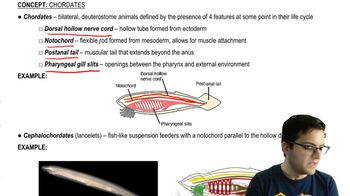
Identify the key characteristics of chordates, which include a notochord, a dorsal hollow nerve cord, pharyngeal slits, and a post-anal tail at some point in their development.
Review the characteristics of the listed animal groups to determine which ones share the most features in common with chordates.
Focus on the evolutionary relationships and phylogenetic tree positioning of chordates relative to other animal groups.
Consider the developmental patterns, such as embryonic development stages and symmetry, which can provide insights into evolutionary relationships.
Conclude by matching the group that is evolutionarily closest to chordates, which are known for their deuterostome development pattern similar to that of chordates.

Verified video answer for a similar problem:

This video solution was recommended by our tutors as helpful for the problem above.
Video duration:
1m
Was this helpful?

Key Concepts

Here are the essential concepts you must grasp in order to answer the question correctly.

Chordates

Chordates are a diverse group of animals that share key features such as a notochord, dorsal nerve cord, pharyngeal slits, and post-anal tail at some stage of their development. This group includes vertebrates like mammals, birds, reptiles, amphibians, and fish, as well as some invertebrate relatives. Understanding the characteristics of chordates is essential for identifying their closest relatives.
Recommended video:

Phylogenetic Relationships

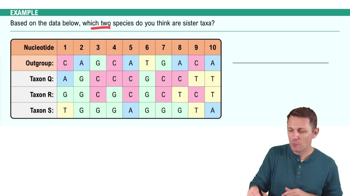
Phylogenetic relationships refer to the evolutionary connections between different groups of organisms, often depicted in a tree-like diagram called a phylogenetic tree. These relationships are determined based on shared characteristics and genetic data, helping to classify organisms according to their evolutionary history. Recognizing these relationships is crucial for matching chordates with their closest relatives.
Recommended video:
04:13
Building Phylogenetic Trees Example 2

Deuterostomes vs. Protostomes

Deuterostomes and protostomes are two major groups of animals distinguished by their embryonic development. Deuterostomes, which include chordates and echinoderms, develop the anus from the blastopore, while protostomes, such as arthropods and molluscs, develop the mouth first. This distinction is important for understanding the evolutionary lineage of chordates and identifying their closest relatives among other animal groups.
Recommended video:
Guided course
03:39
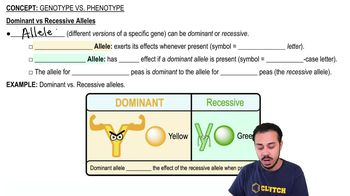
Dominant vs. Recessive Alleles