Textbook Question
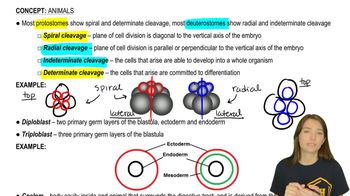
Bilateral symmetry in animals is best correlated with
a. An ability to see equally in all directions.
b. The presence of a skeleton.
c. Motility and active predation and escape.
d. Adaptation to terrestrial environments.
2054
views


 Taylor, Simon, Dickey, Hogan 10th EditionCh. 18 The Evolution of Invertebrate DiversityProblem 6
 Verified step by step guidance
 01:53
01:53
 12:01
12:01 03:39
03:39Bilateral symmetry in animals is best correlated with
a. An ability to see equally in all directions.
b. The presence of a skeleton.
c. Motility and active predation and escape.
d. Adaptation to terrestrial environments.
Jon found an organism in a pond, and he thinks it's a freshwater sponge. His friend Liz thinks it looks more like an aquatic fungus. How can they decide whether it is an animal or a fungus?
a. See if it can swim.
b. Figure out whether it is autotrophic or heterotrophic.
c. See if it is a eukaryote or a prokaryote.
d. Look for cell walls under a microscope.
Which of the following groupings includes the largest number of species? (Explain your answer.)
a. Invertebrates
b. Arthropods
c. Insects
d. Vertebrates
Molecular comparisons place nematodes and arthropods in clade Ecdysozoa. What characteristic do they share that is the basis for the name Ecdysozoa?
a. A complete digestive tract
b. Body segmentation
c. Molting of an exoskeleton
d. Bilateral symmetry
Match each description on the left with the corresponding term on the right Closest relatives of chordates
a. annelids
b. nematodes
c. sponges
d. arthropods
e. flatworms
f. cnidarians
g. molluscs
h. echinoderms
i. chordates