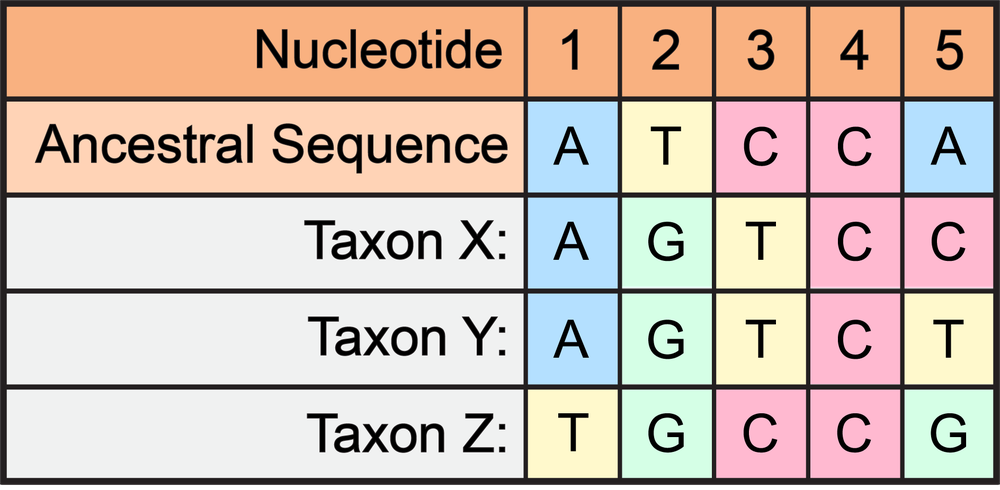
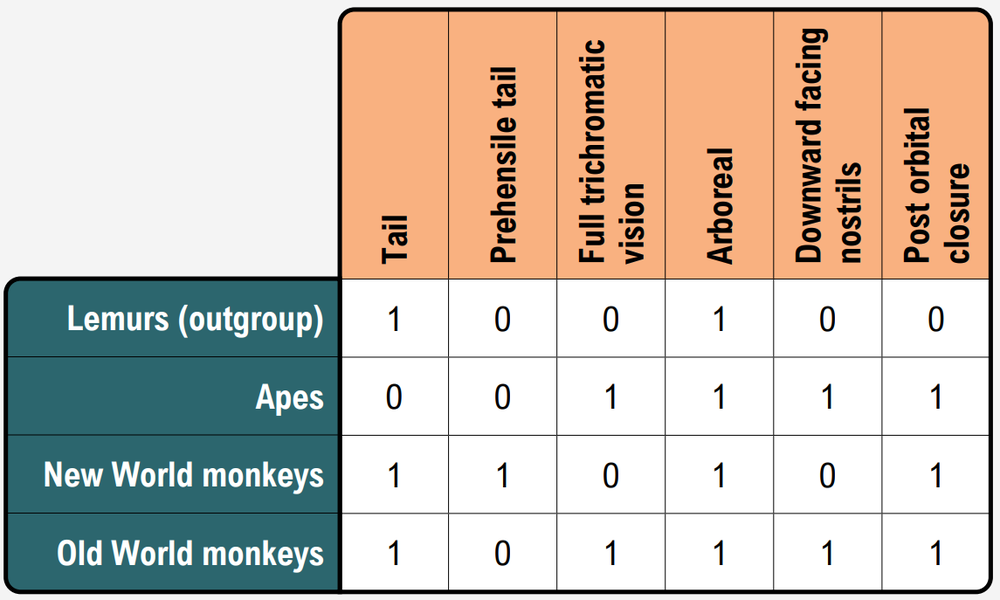
Building phylogenetic trees involves analyzing traits or characters of organisms to infer their evolutionary relationships. Traits can be morphological features, such as bone structures, or genetic information, like DNA sequences. The key to constructing these trees lies in identifying shared characters, which indicate that organisms are more closely related due to a common ancestor.
Shared characters can be categorized into two main types: shared derived characters and shared ancestral characters. Shared derived characters are traits that evolved after the common ancestor of the organisms in question. For instance, mammals like mice and platypuses share derived traits such as mammary glands and hair, which likely evolved in their common ancestor. This allows us to link these two organisms on the phylogenetic tree.
In contrast, shared ancestral characters are traits that were present in the common ancestor of all organisms in the tree. An example is the presence of bones, which is a trait shared by all the organisms in the tree. While this indicates a common ancestry, it does not provide information about the closer relationships among the organisms, as all share this trait.
It is important to differentiate between homologous and analogous characters when building phylogenetic trees. Homologous characters are inherited from a common ancestor, while analogous characters arise independently, often due to similar environmental pressures. For example, both the platypus and the crocodile have webbed feet, but this trait is analogous and does not indicate a close evolutionary relationship. To avoid misinterpretation, utilizing a larger number of characters increases the likelihood of identifying true homologous traits, thereby enhancing the accuracy of the phylogenetic tree.
In summary, the construction of phylogenetic trees relies on the identification of shared derived characters that suggest evolutionary relationships, while being cautious of shared ancestral characters and analogous traits. The more characters analyzed, the more reliable the inferred relationships among organisms will be.