
Pearson+ LogoPearson+ Logo
Ch. 10 Molecular Biology of the Gene
Taylor - Campbell Biology: Concepts & Connections 10th Edition
Taylor, Simon, Dickey, Hogan10th EditionCampbell Biology: Concepts & ConnectionsISBN: 9780136538783Not the one you use?Change textbook
Chapter 10, Problem 11

A mutation in a single gene may cause a major change in the body of a fruit fly, such as an extra pair of legs or wings. Yet it probably takes the combined action of hundreds or thousands of genes to produce a wing or leg. How can a change in just one gene cause such a big change in the body?

Verified step by step guidance
1
Understand the concept of regulatory genes: Regulatory genes are responsible for controlling the expression of other genes. They can act as switches to turn on or off the expression of multiple genes that are involved in complex processes like the development of wings or legs.
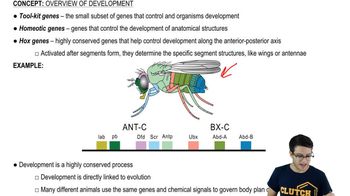
Learn about the role of homeotic genes: Homeotic genes are a type of regulatory gene that determine the identity of body parts. A mutation in a homeotic gene can lead to the development of a body part in the wrong place, such as an extra pair of wings or legs.
Explore the concept of gene networks: Gene networks involve multiple genes interacting with each other to control developmental processes. A mutation in a single regulatory gene can disrupt this network, leading to significant changes in the organism.
Consider the impact of pleiotropy: Pleiotropy occurs when one gene influences multiple phenotypic traits. A mutation in a pleiotropic gene can therefore have widespread effects on the organism's development and morphology.
Examine examples from research: Look into specific case studies or research findings where mutations in single genes have led to major changes in organisms, such as the Antennapedia mutation in fruit flies, which causes legs to grow in place of antennae.

Verified video answer for a similar problem:

This video solution was recommended by our tutors as helpful for the problem above.
Video duration:
2m
Was this helpful?

Key Concepts

Here are the essential concepts you must grasp in order to answer the question correctly.

Gene Regulation

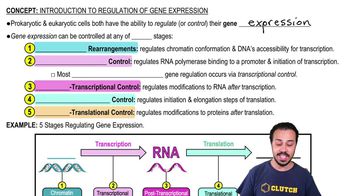
Gene regulation refers to the mechanisms that control the expression of genes, determining when and how much of a gene product is made. This process is crucial because a single gene can influence multiple developmental pathways, leading to significant changes in an organism's phenotype, such as the formation of extra limbs in fruit flies.
Recommended video:
Guided course
06:40
Introduction to Regulation of Gene Expression

Developmental Biology

Developmental biology studies the processes by which organisms grow and develop. It emphasizes how genes interact during development, where a mutation in a single gene can disrupt normal patterns, resulting in major morphological changes, like additional legs or wings, by altering the timing or location of developmental signals.
Recommended video:

Epistasis

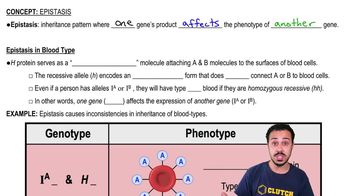
Epistasis is a genetic interaction where the effect of one gene is modified by one or several other genes. This concept is important in understanding how a mutation in one gene can have a cascading effect on the expression of other genes, leading to complex traits and significant phenotypic changes, as seen in the altered body structures of fruit flies.
Recommended video:
Related Practice
Textbook Question
A cell containing a single chromosome is placed in a medium containing radioactive phosphate so that any new DNA strands formed by DNA replication will be radioactive. The cell replicates its DNA and divides. Then the daughter cells (still in the radioactive medium) replicate their DNA and divide, and a total of four cells are present. Sketch the DNA molecules in all four cells, showing a normal (nonradioactive) DNA strand as a solid line and a radioactive DNA strand as a dashed line.
896
views
Textbook Question
The base sequence of the gene coding for a short polypeptide is CTACGCTAGGCGATTGACT. What would be the base sequence of the mRNA transcribed from this gene? Using the genetic code, give the amino acid sequence of the polypeptide translated from this mRNA. (Hint: What is the start codon?)
1909
views
Textbook Question

Researchers working on the Human Genome Project have determined the nucleotide sequences of human genes and in many cases identified the proteins encoded by the genes. Knowledge of the nucleotide sequences of genes might be used to develop lifesaving medicines or treatments for genetic defects. In the United States, both government agencies and biotechnology companies have applied for patents on their discoveries of genes. In Britain, the courts have ruled that a naturally occurring gene cannot be patented. Do you think individuals and companies should be able to patent genes and gene products?

1193
views
Textbook Question
A chemical called dioxin is produced as a by-product of some chemical manufacturing processes. This substance was present in Agent Orange, a defoliant sprayed on vegetation during the Vietnam War. There has been a continuing controversy over its effects on soldiers exposed to it during the war. Animal tests have suggested that dioxin can be lethal and can cause birth defects, cancer, organ damage, and immune system suppression. But its effects on humans are unclear, and even animal tests are inconclusive. Researchers have discovered that dioxin enters a cell and binds to a protein that in turn attaches to the cell's DNA. How might this mechanism help explain the variety of dioxin's effects? How might you determine whether a particular individual became ill as a result of exposure to dioxin?
815
views