
Pearson+ LogoPearson+ Logo
Ch. 10 Molecular Biology of the Gene
Taylor - Campbell Biology: Concepts & Connections 10th Edition
Taylor, Simon, Dickey, Hogan10th EditionCampbell Biology: Concepts & ConnectionsISBN: 9780136538783Not the one you use?Change textbook
Chapter 10, Problem 9

A cell containing a single chromosome is placed in a medium containing radioactive phosphate so that any new DNA strands formed by DNA replication will be radioactive. The cell replicates its DNA and divides. Then the daughter cells (still in the radioactive medium) replicate their DNA and divide, and a total of four cells are present. Sketch the DNA molecules in all four cells, showing a normal (nonradioactive) DNA strand as a solid line and a radioactive DNA strand as a dashed line.

Verified step by step guidance
1
Step 1: Understand the initial condition of the cell. The cell starts with one chromosome, which consists of two DNA strands intertwined in a double helix. Since the cell is placed in a medium with radioactive phosphate before any replication occurs, only the new strands synthesized will incorporate the radioactive material.
Step 2: Visualize the first round of DNA replication. Each strand of the original DNA serves as a template for a new strand. Since the new strands are synthesized in the presence of radioactive phosphate, they will be radioactive. Represent the original DNA strand as a solid line and the new, radioactive strand as a dashed line. After replication, each chromosome will consist of one solid line and one dashed line.
Step 3: Consider the cell division that follows the first DNA replication. The cell divides into two daughter cells, each inheriting one chromosome from the original cell. Each of these chromosomes will have one solid line (original non-radioactive strand) and one dashed line (new radioactive strand).
Step 4: Account for the second round of DNA replication in the daughter cells, which are still in the radioactive medium. Each strand (solid and dashed) in both daughter cells now acts as a template for a new strand. The new strands synthesized will again be radioactive (dashed lines). After this replication, each chromosome in the daughter cells will consist of one solid line paired with one dashed line and one dashed line paired with another dashed line.
Step 5: Sketch the final outcome after the second cell division, resulting in four cells. Each of these four cells will contain chromosomes as described in step 4. Two cells will have chromosomes with one solid line and one dashed line, and two cells will have chromosomes with both strands as dashed lines, indicating they are fully radioactive.

Verified video answer for a similar problem:

This video solution was recommended by our tutors as helpful for the problem above.
Video duration:
3m
Was this helpful?

Key Concepts

Here are the essential concepts you must grasp in order to answer the question correctly.

DNA Structure and Replication

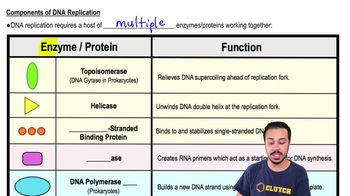
DNA is composed of two strands forming a double helix, with each strand made up of nucleotides. During DNA replication, the double helix unwinds, and each original strand serves as a template for synthesizing a new complementary strand. This process ensures that each daughter cell receives an identical copy of the DNA, with the new strands being synthesized alongside the original strands.
Recommended video:
Guided course
04:47
Components of DNA Replication

Radioactive Labeling in Molecular Biology

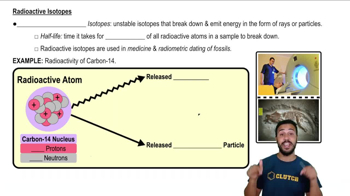
Radioactive labeling involves incorporating radioactive isotopes, such as radioactive phosphate, into molecules to trace their incorporation and behavior in biological processes. In this scenario, the radioactive phosphate is incorporated into the newly synthesized DNA strands during replication, allowing for the differentiation between newly formed (radioactive) and original (nonradioactive) DNA strands in the daughter cells.
Recommended video:
Guided course
02:37
Radioactive Isotopes

Cell Division and Genetic Distribution

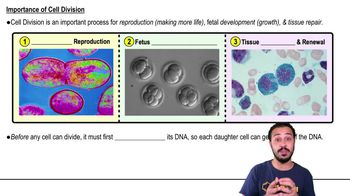
Cell division, specifically mitosis, is the process by which a single cell divides to produce two daughter cells, each containing an identical set of chromosomes. In this case, after the initial DNA replication and division, the daughter cells continue to replicate their DNA in the radioactive medium, leading to a predictable pattern of radioactive and nonradioactive DNA strands in the resulting four cells, which can be illustrated in a sketch.
Recommended video:
Guided course
03:19
Importance of Cell Division
Related Practice
Textbook Question

A geneticist found that a particular mutation had no effect on the polypeptide encoded by a gene. This mutation probably involved

a. Deletion of one nucleotide

b. Alteration of the start codon

c. Insertion of one nucleotide

d. Substitution of one nucleotide

1799
views
Textbook Question
Describe the process by which the information in a eukaryotic gene is transcribed and translated into a protein. Correctly use these words in your description: tRNA, amino acid, start codon, transcription, RNA splicing, exons, introns, mRNA, gene, codon, RNA polymerase, ribosome, translation, anticodon, peptide bond, stop codon.
2002
views
Textbook Question

The nucleotide sequence of a DNA codon is GTA. A messenger RNA molecule with a complementary codon is transcribed from the DNA. In the process of protein synthesis, a transfer RNA pairs with the mRNA codon. What is the nucleotide sequence of the tRNA anticodon?

a. CAT

b. CUT

c. GUA

d. CAU

1798
views
Textbook Question
The base sequence of the gene coding for a short polypeptide is CTACGCTAGGCGATTGACT. What would be the base sequence of the mRNA transcribed from this gene? Using the genetic code, give the amino acid sequence of the polypeptide translated from this mRNA. (Hint: What is the start codon?)
1909
views
Textbook Question

Researchers working on the Human Genome Project have determined the nucleotide sequences of human genes and in many cases identified the proteins encoded by the genes. Knowledge of the nucleotide sequences of genes might be used to develop lifesaving medicines or treatments for genetic defects. In the United States, both government agencies and biotechnology companies have applied for patents on their discoveries of genes. In Britain, the courts have ruled that a naturally occurring gene cannot be patented. Do you think individuals and companies should be able to patent genes and gene products?

1193
views
Textbook Question
A mutation in a single gene may cause a major change in the body of a fruit fly, such as an extra pair of legs or wings. Yet it probably takes the combined action of hundreds or thousands of genes to produce a wing or leg. How can a change in just one gene cause such a big change in the body?
1203
views