Pearson+ LogoPearson+ Logo
Ch. 3 The Molecules of Cells
Taylor - Campbell Biology: Concepts & Connections 10th Edition
Taylor, Simon, Dickey, Hogan10th EditionCampbell Biology: Concepts & ConnectionsISBN: 9780136538783Not the one you use?Change textbook
Chapter 3, Problem 1

Complete the following table to help you review the structures and functions of the four classes of organic molecules. Table summarizing classes of biomolecules, their functions, and examples for biology course.

Verified step by step guidance
1
Identify the four classes of organic molecules: Carbohydrates, Lipids, Proteins, and Nucleic Acids.
For Carbohydrates, fill in the functions and examples: b. Energy storage, c. Cellulose.
For Lipids, fill in the functions and examples: d. Fats, e. Membrane structure, f. Steroids.
For Proteins, fill in the functions and examples: g. Enzymes, h. Structural proteins, i. Amino acids, j. Catalysis, k. Structural support, l. Movement, m. Defense, n. Storage.
For Nucleic Acids, fill in the functions and examples: o. Genetic information storage, p. Nucleotides, q. DNA and RNA, r. Genetic material, s. Information transfer.

Verified video answer for a similar problem:

This video solution was recommended by our tutors as helpful for the problem above.
Video duration:
41s
Was this helpful?

Key Concepts

Here are the essential concepts you must grasp in order to answer the question correctly.

Carbohydrates

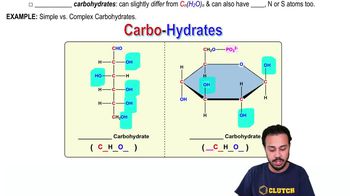
Carbohydrates are organic molecules composed of carbon, hydrogen, and oxygen, typically in a ratio of 1:2:1. They serve as a primary energy source for cells and play crucial roles in structural support, particularly in plant cell walls. Common examples include sugars like glucose and polysaccharides such as starch and glycogen, which store energy.
Recommended video:
Guided course
04:53
Carbohydrates

Lipids

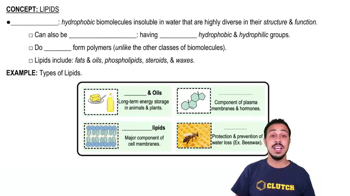
Lipids are a diverse group of hydrophobic organic molecules, including fats, oils, and phospholipids. They do not form polymers and are primarily involved in energy storage, insulation, and forming cell membranes. Lipids also serve as signaling molecules, with hormones being a key example, influencing various physiological processes.
Recommended video:

Proteins

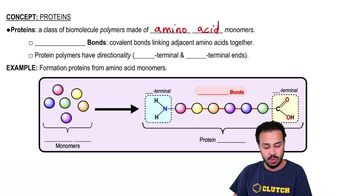
Proteins are large, complex molecules made up of amino acids linked by peptide bonds. They perform a wide range of functions in biological systems, including catalyzing biochemical reactions (enzymes), transporting molecules, and providing structural support. Proteins are essential for growth, repair, and regulation of body processes, with examples including enzymes like lactase and structural proteins like collagen.
Recommended video: