Pearson+ LogoPearson+ Logo
Ch. 3 The Molecules of Cells
Taylor - Campbell Biology: Concepts & Connections 10th Edition
Taylor, Simon, Dickey, Hogan10th EditionCampbell Biology: Concepts & ConnectionsISBN: 9780136538783Not the one you use?Change textbook
Chapter 3, Problem 3

What makes a fatty acid an acid?
a. It does not dissolve in water.
b. It is capable of bonding with other molecules to form a fat.
c. It has a carboxyl group that can donate an H+ to a solution.
d. It contains only two oxygen atoms.

Verified step by step guidance
1
Understand the structure of a fatty acid: Fatty acids are composed of a long hydrocarbon chain and a carboxyl group (-COOH) at one end.
Learn what makes a molecule an acid: Acids are substances that can donate hydrogen ions (H⁺) to a solution. This is a key property of acids in chemistry and biology.
Examine the carboxyl group (-COOH): The carboxyl group in fatty acids is capable of donating an H⁺ ion because the hydrogen atom in the -COOH group is weakly bonded and can dissociate in aqueous solutions.
Evaluate the options provided: Option c states that a fatty acid has a carboxyl group that can donate an H⁺ to a solution, which aligns with the definition of an acid. The other options do not directly explain why a fatty acid is classified as an acid.
Conclude that the presence of the carboxyl group (-COOH) and its ability to donate H⁺ ions is the defining characteristic that makes a fatty acid an acid.

Verified video answer for a similar problem:

This video solution was recommended by our tutors as helpful for the problem above.
Video duration:
2m
Was this helpful?

Key Concepts

Here are the essential concepts you must grasp in order to answer the question correctly.

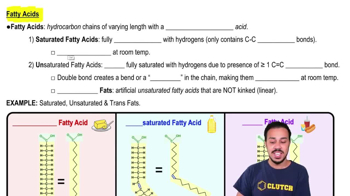
Fatty Acids

Fatty acids are long hydrocarbon chains with a carboxyl group (-COOH) at one end. They are key components of lipids, which include fats and oils. The structure of fatty acids influences their properties, such as solubility and melting point, and they play crucial roles in energy storage and cellular functions.
Recommended video:

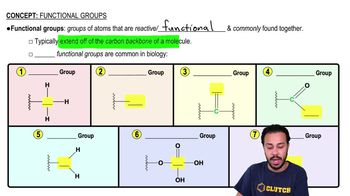
Carboxyl Group

The carboxyl group is a functional group characterized by a carbon atom double-bonded to an oxygen atom and single-bonded to a hydroxyl group (-OH). This group is responsible for the acidic properties of fatty acids, as it can donate a hydrogen ion (H+) to a solution, thus increasing the acidity of the solution.
Recommended video:
Guided course
06:04
Functional Groups

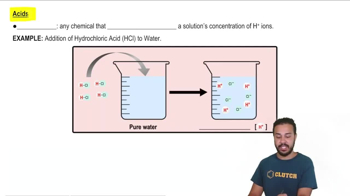
Acidity and Proton Donation

Acidity in chemistry refers to the ability of a substance to donate protons (H+) to a solution. In the context of fatty acids, the presence of the carboxyl group allows them to release H+ ions, which is what classifies them as acids. This property is essential for understanding their behavior in biological systems and their interactions with other molecules.
Recommended video: