Pearson+ LogoPearson+ Logo
Ch. 9 Patterns of Inheritance
Taylor - Campbell Biology: Concepts & Connections 10th Edition
Taylor, Simon, Dickey, Hogan10th EditionCampbell Biology: Concepts & ConnectionsISBN: 9780136538783Not the one you use?Change textbook
Chapter 9, Problem 2

Whether an allele is dominant or recessive depends on
a. How common the allele is, relative to other alleles
b. Whether it is inherited from the mother or the father
c. Whether it or another allele determines the phenotype when both are present
d. Whether or not it is linked to other genes

Verified step by step guidance
1
Understand the concept of alleles: Alleles are different forms of a gene that can exist at a specific locus on a chromosome. They can be dominant or recessive, which affects how they influence the phenotype.
Review the definition of dominant and recessive alleles: A dominant allele is one that expresses its trait in the phenotype even when only one copy is present (heterozygous condition). A recessive allele requires two copies (homozygous condition) to express its trait in the phenotype.
Focus on the key factor that determines dominance or recessiveness: Dominance or recessiveness is determined by how the alleles interact to produce the phenotype when both are present. Specifically, a dominant allele will mask the effect of a recessive allele in a heterozygous individual.
Eliminate incorrect options: a) The frequency of an allele in a population does not determine whether it is dominant or recessive. b) Whether an allele is inherited from the mother or father does not affect its dominance or recessiveness. d) Linkage to other genes does not determine dominance or recessiveness.
Conclude with the correct answer: The correct answer is c) whether it or another allele determines the phenotype when both are present. This is the defining characteristic of dominant and recessive alleles.

Verified video answer for a similar problem:

This video solution was recommended by our tutors as helpful for the problem above.
Video duration:
1m
Was this helpful?

Key Concepts

Here are the essential concepts you must grasp in order to answer the question correctly.

Dominance in Alleles

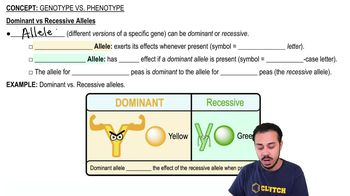
Dominance refers to the relationship between alleles of a gene, where a dominant allele masks the effect of a recessive allele in a heterozygous individual. This means that if an individual has one dominant and one recessive allele, the dominant trait will be expressed in the phenotype, while the recessive trait will not.
Recommended video:
Guided course
03:39
Dominant vs. Recessive Alleles

Phenotype Expression

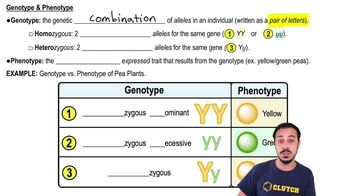
Phenotype is the observable physical or biochemical characteristics of an organism, determined by both genetic makeup and environmental influences. The expression of a phenotype can be influenced by the dominance of alleles, where the presence of a dominant allele will dictate the visible traits, regardless of the recessive allele's presence.
Recommended video:
Guided course
06:36
Genotype & Phenotype

Genetic Linkage

Genetic linkage refers to the tendency of alleles that are located close to each other on a chromosome to be inherited together during meiosis. While linkage can affect inheritance patterns, it does not directly determine whether an allele is dominant or recessive; rather, it influences the likelihood of allele combinations in offspring.
Recommended video: