Pearson+ LogoPearson+ Logo
Ch. 9 Patterns of Inheritance
Taylor - Campbell Biology: Concepts & Connections 10th Edition
Taylor, Simon, Dickey, Hogan10th EditionCampbell Biology: Concepts & ConnectionsISBN: 9780136538783Not the one you use?Change textbook
Chapter 9, Problem 3

Edward was found to be heterozygous (Ss) for sickle-cell trait. The alleles represented by the letters S and s are
a. Linked
b. On homologous chromosomes
c. Both present in each of Edward's sperm cells
d. On the same chromosome but far apart

Verified step by step guidance
1
Understand the concept of heterozygosity: Edward is heterozygous for the sickle-cell trait, meaning he has two different alleles for the gene in question—one dominant (S) and one recessive (s). These alleles are located on homologous chromosomes.
Recall the definition of homologous chromosomes: Homologous chromosomes are pairs of chromosomes (one from each parent) that have the same genes at the same loci but may have different alleles. In Edward's case, the S allele is on one chromosome, and the s allele is on the other chromosome of the homologous pair.
Consider the process of gamete formation (meiosis): During meiosis, homologous chromosomes are separated, and each gamete (sperm cell) receives only one chromosome from each homologous pair. This means that each sperm cell will carry either the S allele or the s allele, but not both.
Evaluate the options provided: Since the alleles S and s are on homologous chromosomes, they are not linked (linked genes are located close together on the same chromosome). Additionally, both alleles cannot be present in the same sperm cell because meiosis separates homologous chromosomes.
Conclude that the correct answer is: The alleles S and s are on homologous chromosomes, as this aligns with the principles of genetics and meiosis.

Verified video answer for a similar problem:

This video solution was recommended by our tutors as helpful for the problem above.
Video duration:
52s
Was this helpful?

Key Concepts

Here are the essential concepts you must grasp in order to answer the question correctly.

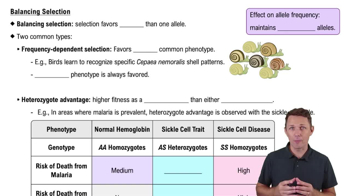
Heterozygosity

Heterozygosity refers to the presence of two different alleles at a specific gene locus on homologous chromosomes. In this case, Edward's genotype 'Ss' indicates that he has one dominant allele (S) and one recessive allele (s) for the sickle-cell trait. This genetic variation can influence the expression of traits and is crucial for understanding inheritance patterns.
Recommended video:
06:29
Balancing Selection

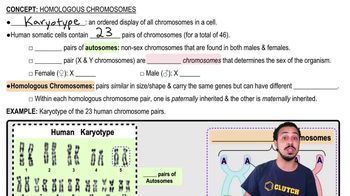
Homologous Chromosomes

Homologous chromosomes are pairs of chromosomes in a diploid organism that have the same structure and gene sequence but may carry different alleles. Each parent contributes one chromosome to the pair, resulting in one allele from each parent. In Edward's case, the alleles S and s are located on homologous chromosomes, which is essential for proper segregation during meiosis.
Recommended video:
Guided course
08:09
Homologous Chromosomes

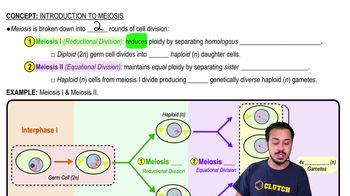
Meiosis and Gamete Formation

Meiosis is the process of cell division that produces gametes (sperm and eggs) with half the number of chromosomes of the parent cell. During meiosis, homologous chromosomes are separated, ensuring that each gamete receives one allele from each gene pair. For Edward, this means that his sperm cells will carry either the S or the s allele, but not both, which is critical for understanding inheritance patterns in offspring.
Recommended video:
Guided course
04:49
Meiosis I & Meiosis II