Pearson+ LogoPearson+ Logo
Ch. 9 Patterns of Inheritance
Taylor - Campbell Biology: Concepts & Connections 10th Edition
Taylor, Simon, Dickey, Hogan10th EditionCampbell Biology: Concepts & ConnectionsISBN: 9780136538783Not the one you use?Change textbook
Chapter 9, Problem 4

Two fruit flies with eyes of the usual red color are crossed, and their offspring are as follows: 77 red-eyed males, 71 ruby-eyed males, 152 red-eyed females. The allele for ruby eyes is
a. Autosomal (carried on an autosome) and dominant
b. Autosomal and recessive
c. Sex-linked and dominant
d. Sex-linked and recessive

Verified step by step guidance
1
Step 1: Understand the problem. The question is asking about the inheritance pattern of the ruby-eyed trait in fruit flies. The options include whether the trait is autosomal (on a non-sex chromosome) or sex-linked (on a sex chromosome), and whether it is dominant or recessive.
Step 2: Analyze the offspring data. The offspring include 77 red-eyed males, 71 ruby-eyed males, and 152 red-eyed females. Note that there are no ruby-eyed females in the offspring, which is a key observation.
Step 3: Consider the possibility of sex-linked inheritance. In sex-linked traits, males (XY) inherit their X chromosome from their mother and their Y chromosome from their father. If the ruby-eyed trait is sex-linked and recessive, only males would express the trait if they inherit the recessive allele on their single X chromosome.
Step 4: Rule out autosomal inheritance. If the ruby-eyed trait were autosomal, we would expect to see both males and females with ruby eyes in the offspring, assuming Mendelian inheritance. However, no ruby-eyed females are observed, which suggests the trait is not autosomal.
Step 5: Conclude the inheritance pattern. Based on the data, the ruby-eyed trait is most consistent with being sex-linked and recessive. This explains why only males exhibit the ruby-eyed phenotype, as they inherit the recessive allele on their X chromosome from their mother.

Verified video answer for a similar problem:

This video solution was recommended by our tutors as helpful for the problem above.
Video duration:
1m
Was this helpful?

Key Concepts

Here are the essential concepts you must grasp in order to answer the question correctly.

Mendelian Genetics

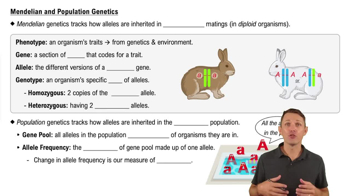
Mendelian genetics is the study of how traits are inherited through generations based on the principles established by Gregor Mendel. It involves understanding dominant and recessive alleles, which determine the phenotype of an organism. In this case, the inheritance pattern of eye color in fruit flies can be analyzed using Mendelian ratios to deduce the nature of the alleles involved.
Recommended video:
04:26
Mendelian and Population Genetics

Autosomal vs. Sex-linked Traits

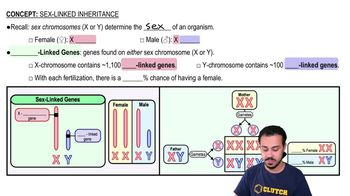
Traits can be classified as autosomal or sex-linked based on their location on chromosomes. Autosomal traits are carried on non-sex chromosomes and affect both sexes equally, while sex-linked traits are found on sex chromosomes and often exhibit different patterns of inheritance in males and females. Understanding this distinction is crucial for interpreting the inheritance of eye color in the fruit flies.
Recommended video:
Guided course
04:17
Sex-Linked Inheritance

Phenotypic Ratios

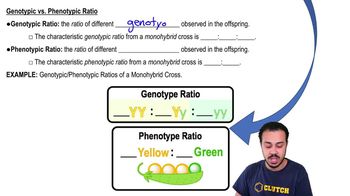
Phenotypic ratios represent the relative frequencies of different phenotypes in the offspring of a genetic cross. By analyzing the observed ratios of red-eyed and ruby-eyed fruit flies, one can infer the underlying genetic mechanisms. In this scenario, the ratio of red to ruby-eyed males and females provides insight into whether the ruby eye allele is dominant or recessive, and whether it is autosomal or sex-linked.
Recommended video:
Guided course
02:48
Genotypic vs. Phenotypic Ratio