Pearson+ LogoPearson+ Logo
Ch. 7 Photosynthesis: Using Light to Make Food
Taylor - Campbell Biology: Concepts & Connections 10th Edition
Taylor, Simon, Dickey, Hogan10th EditionCampbell Biology: Concepts & ConnectionsISBN: 9780136538783Not the one you use?Change textbook
Chapter 7, Problem 15

Continue your comparison of electron transport and chemiosmosis in mitochondria and chloroplasts. In each case:
a. Where do the electrons come from?
b. How do the electrons get their high potential energy?
c. What picks up the electrons at the end of the chain?
d. How is the energy released as electrons are transferred down the electron transport chain used?

Verified step by step guidance
1
a. Identify the source of electrons in each organelle: In mitochondria, electrons come from NADH and FADH2, which are produced during glycolysis, the citric acid cycle, and beta-oxidation. In chloroplasts, electrons originate from water molecules (H2O) that are split during the light-dependent reactions of photosynthesis.
b. Explain how electrons gain high potential energy: In mitochondria, electrons gain high potential energy during the oxidation of glucose and other molecules, as NADH and FADH2 are reduced. In chloroplasts, electrons gain high potential energy when photons of light excite chlorophyll molecules in the photosystems, particularly Photosystem II.
c. Determine the final electron acceptor: In mitochondria, the final electron acceptor is molecular oxygen (O2), which combines with protons to form water (H2O). In chloroplasts, the final electron acceptor is NADP+, which is reduced to form NADPH during the light-dependent reactions.
d. Describe how energy is used: In both mitochondria and chloroplasts, the energy released as electrons are transferred down the electron transport chain is used to pump protons (H+) across a membrane, creating a proton gradient. In mitochondria, this occurs across the inner mitochondrial membrane, while in chloroplasts, it occurs across the thylakoid membrane.
e. Explain the role of the proton gradient: The proton gradient created in both organelles drives ATP synthesis. Protons flow back across the membrane through ATP synthase, a process called chemiosmosis, which provides the energy needed to convert ADP and inorganic phosphate (Pi) into ATP.

Verified video answer for a similar problem:

This video solution was recommended by our tutors as helpful for the problem above.
Video duration:
2m
Was this helpful?

Key Concepts

Here are the essential concepts you must grasp in order to answer the question correctly.

Electron Transport Chain (ETC)

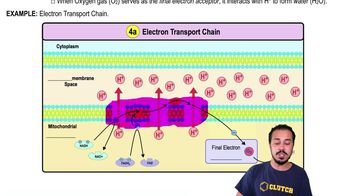
The electron transport chain is a series of protein complexes located in the inner mitochondrial membrane and thylakoid membrane of chloroplasts. It facilitates the transfer of electrons derived from electron donors like NADH and FADH2 in mitochondria, and from water in chloroplasts. As electrons move through the chain, they release energy, which is used to pump protons across the membrane, creating a proton gradient.
Recommended video:
Guided course
07:41
Electron Transport Chain

Chemiosmosis

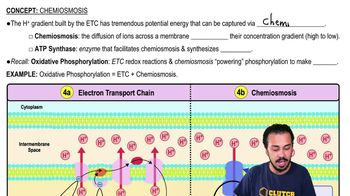
Chemiosmosis is the process by which ATP is produced using the energy stored in a proton gradient across a membrane. In mitochondria, protons flow back into the matrix through ATP synthase, driving the conversion of ADP and inorganic phosphate into ATP. This mechanism is similar in chloroplasts, where protons flow back into the stroma, facilitating ATP synthesis during photosynthesis.
Recommended video:

High Potential Energy of Electrons

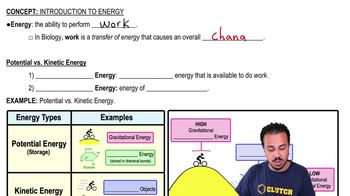
Electrons gain high potential energy through processes such as photolysis in chloroplasts, where light energy splits water molecules, and through the oxidation of substrates in mitochondria. This energy is harnessed as electrons are transferred through the ETC, allowing them to do work, such as pumping protons and ultimately driving ATP synthesis. The energy state of electrons is crucial for the efficiency of cellular respiration and photosynthesis.
Recommended video:
Guided course
04:58
Introduction to Energy