Pearson+ LogoPearson+ Logo
Ch. 7 Photosynthesis: Using Light to Make Food
Taylor - Campbell Biology: Concepts & Connections 10th Edition
Taylor, Simon, Dickey, Hogan10th EditionCampbell Biology: Concepts & ConnectionsISBN: 9780136538783Not the one you use?Change textbook
Chapter 7, Problem 13

Explain what is meant by saying the light reactions convert solar energy to chemical energy.

Verified step by step guidance
1
Understand that the light reactions are the first stage of photosynthesis, taking place in the thylakoid membranes of chloroplasts.
Recognize that solar energy refers to the energy from sunlight, which is composed of photons.
Learn that chlorophyll and other pigments in the thylakoid membranes absorb these photons, initiating the light reactions.
Realize that the absorbed light energy is used to split water molecules into oxygen, protons, and electrons, a process known as photolysis.
Acknowledge that the electrons move through the electron transport chain, leading to the production of ATP and NADPH, which are forms of chemical energy used in the subsequent Calvin cycle to synthesize glucose.

Verified video answer for a similar problem:

This video solution was recommended by our tutors as helpful for the problem above.
Video duration:
1m
Was this helpful?

Key Concepts

Here are the essential concepts you must grasp in order to answer the question correctly.

Photosynthesis

Photosynthesis is the biological process by which green plants, algae, and some bacteria convert light energy into chemical energy. This process primarily occurs in the chloroplasts of plant cells, where chlorophyll captures sunlight and uses it to transform carbon dioxide and water into glucose and oxygen.
Recommended video:
Guided course
05:58
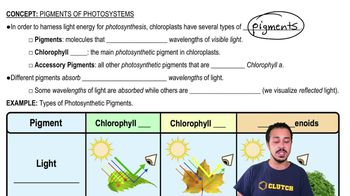
Pigments of Photosynthesis

Light Reactions

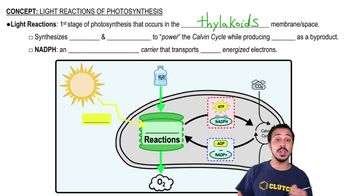
The light reactions are the first stage of photosynthesis, occurring in the thylakoid membranes of chloroplasts. During this phase, sunlight is absorbed by chlorophyll, leading to the production of ATP and NADPH, which are energy-rich molecules. Water is also split, releasing oxygen as a byproduct.
Recommended video:
Guided course
04:06
Light Reactions of Photosynthesis

Chemical Energy

Chemical energy is the energy stored in the bonds of chemical compounds, such as glucose produced during photosynthesis. This energy can be released during cellular respiration, allowing organisms to perform work. The conversion of solar energy to chemical energy is crucial for sustaining life on Earth, as it forms the basis of the food chain.
Recommended video:
Guided course
01:56
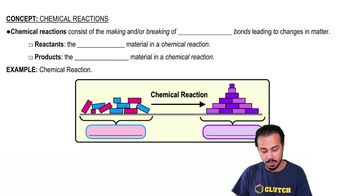
Chemical Reactions
Related Practice
Textbook Question

To synthesize one glucose molecule, the Calvin cycle uses _________ molecules of CO₂, _________ molecules of ATP, and _________ molecules of NADPH.

1626
views
Textbook Question

Compare and describe the roles of CO₂ and H₂O in cellular respiration and photosynthesis.

1487
views
Textbook Question
What do plants do with the sugar they produce in photosynthesis?
2508
views
Textbook Question

The following diagram compares the chemiosmotic synthesis of ATP in mitochondria and chloroplasts. Identify the components that are shared by both organelles and indicate which side of the membrane has the higher H+ concentration. Then label on the right the locations within the chloroplast.

<IMAGE>

1864
views
Textbook Question

Continue your comparison of electron transport and chemiosmosis in mitochondria and chloroplasts. In each case:

a. Where do the electrons come from?

b. How do the electrons get their high potential energy?

c. What picks up the electrons at the end of the chain?

d. How is the energy released as electrons are transferred down the electron transport chain used?

1401
views
Textbook Question

Most scientific experts agree that climate change is already occurring and has potentially catastrophic consequences for all of life on Earth. The Paris Agreement of 2015 represented a global consensus on the need to reduce greenhouse gas emissions. However, in 2017 the United States announced its intention to withdraw from the Agreement in 2020. Go online to research and summarize the main agreements reached in this historic global climate accord and the U.S. government's reasons for withdrawing. What roles do you think scientists, politicians, and citizens will need to play to cut emissions and limit global warming?

1264
views