
Pearson+ LogoPearson+ Logo
Ch. 7 Photosynthesis: Using Light to Make Food
Taylor - Campbell Biology: Concepts & Connections 10th Edition
Taylor, Simon, Dickey, Hogan10th EditionCampbell Biology: Concepts & ConnectionsISBN: 9780136538783Not the one you use?Change textbook
Chapter 7, Problem 10

Compare and describe the roles of CO₂ and H₂O in cellular respiration and photosynthesis.

Verified step by step guidance
1
Understand the processes: Cellular respiration and photosynthesis are complementary biological processes. Cellular respiration occurs in the mitochondria of cells and breaks down glucose to produce energy (ATP), while photosynthesis occurs in the chloroplasts of plants and some other organisms to produce glucose using light energy.
Role of CO2 in photosynthesis: In photosynthesis, carbon dioxide (CO2) is a reactant. It is taken in by plants and used in the Calvin cycle to produce glucose (C6H12O6). The general equation for photosynthesis is: 6CO2 + 6H2O + lightC6H12O6 + 6O2.
Role of H2O in photosynthesis: Water (H2O) is also a reactant in photosynthesis. It is split during the light-dependent reactions to release oxygen (O2) as a byproduct and provide electrons and protons for the production of energy carriers like ATP and NADPH.
Role of CO2 in cellular respiration: In cellular respiration, CO2 is a product. It is released during the breakdown of glucose in the Krebs cycle (citric acid cycle) as glucose is oxidized to produce energy. The general equation for cellular respiration is: C6H12O6 + 6O26CO2 + 6H2O + ATP.
Role of H2O in cellular respiration: Water (H2O) is a product of cellular respiration. It is formed when oxygen (O2) acts as the final electron acceptor in the electron transport chain, combining with electrons and protons to form water. This step is crucial for the generation of ATP through oxidative phosphorylation.

Verified video answer for a similar problem:

This video solution was recommended by our tutors as helpful for the problem above.
Video duration:
1m
Was this helpful?

Key Concepts

Here are the essential concepts you must grasp in order to answer the question correctly.

Cellular Respiration

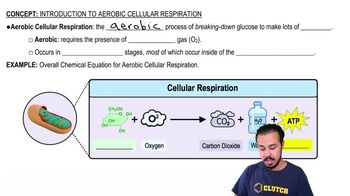
Cellular respiration is a metabolic process in which cells convert glucose and oxygen into energy, carbon dioxide, and water. This process occurs in three main stages: glycolysis, the Krebs cycle, and oxidative phosphorylation. It is essential for producing ATP, the energy currency of the cell, and plays a crucial role in maintaining cellular functions.
Recommended video:
Guided course
03:39
Introduction to Cellular Respiration

Photosynthesis

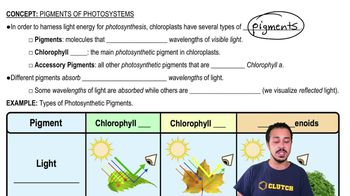
Photosynthesis is the process by which green plants, algae, and some bacteria convert light energy into chemical energy, using carbon dioxide and water to produce glucose and oxygen. This process occurs mainly in the chloroplasts and involves two stages: the light-dependent reactions and the Calvin cycle. Photosynthesis is vital for producing organic compounds and oxygen, supporting life on Earth.
Recommended video:
Guided course
05:58
Pigments of Photosynthesis

Role of CO2 and H2O

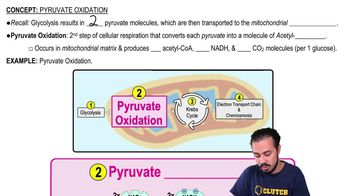
In cellular respiration, carbon dioxide is a byproduct of glucose breakdown, while water is produced during the electron transport chain. In contrast, during photosynthesis, carbon dioxide and water are reactants that, through a series of reactions, are transformed into glucose and oxygen. Thus, CO2 and H2O serve as essential substrates in photosynthesis and as products in cellular respiration, highlighting their interconnected roles in the ecosystem.
Recommended video:
Guided course
04:38
Pyruvate Oxidation