Pearson+ LogoPearson+ Logo
Ch. 7 Photosynthesis: Using Light to Make Food
Taylor - Campbell Biology: Concepts & Connections 10th Edition
Taylor, Simon, Dickey, Hogan10th EditionCampbell Biology: Concepts & ConnectionsISBN: 9780136538783Not the one you use?Change textbook
Chapter 7, Problem 3

Which of the following are produced by reactions that take place in the thylakoids and consumed by reactions in the stroma?
a. CO₂ and H₂O
b. ATP and NADPH
c. ATP, NADPH, and CO₂
d. ATP, NADPH, and O₂

Verified step by step guidance
1
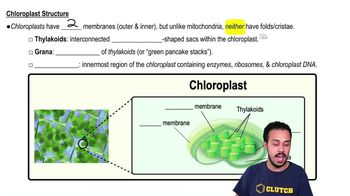
Understand the structure of chloroplasts: The thylakoids are membrane-bound structures within chloroplasts where the light-dependent reactions of photosynthesis occur. The stroma is the fluid-filled space surrounding the thylakoids where the light-independent reactions (Calvin cycle) take place.
Recall the purpose of light-dependent reactions: These reactions occur in the thylakoids and convert light energy into chemical energy in the form of ATP and NADPH. Oxygen (O2) is also produced as a byproduct during the splitting of water (H2O).
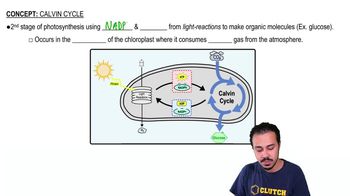
Understand the role of ATP and NADPH: ATP and NADPH produced in the thylakoids are used in the stroma during the Calvin cycle to drive the synthesis of glucose from carbon dioxide (CO2).
Eliminate incorrect options: CO2 is consumed in the stroma during the Calvin cycle, not produced in the thylakoids. O2 is produced in the thylakoids but not consumed in the stroma. Therefore, options involving CO2 and O2 can be ruled out.
Identify the correct answer: ATP and NADPH are produced in the thylakoids during light-dependent reactions and consumed in the stroma during the Calvin cycle. Thus, the correct answer is b. ATP and NADPH.

Verified video answer for a similar problem:

This video solution was recommended by our tutors as helpful for the problem above.
Video duration:
4m
Was this helpful?

Key Concepts

Here are the essential concepts you must grasp in order to answer the question correctly.

Photosynthesis

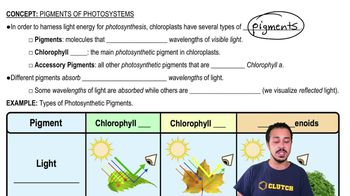
Photosynthesis is the process by which green plants, algae, and some bacteria convert light energy into chemical energy, primarily in the form of glucose. This process occurs in two main stages: the light-dependent reactions, which take place in the thylakoids, and the light-independent reactions (Calvin cycle), which occur in the stroma of chloroplasts.
Recommended video:
Guided course
05:58
Pigments of Photosynthesis

Thylakoids

Thylakoids are membrane-bound structures within chloroplasts that contain chlorophyll and are the site of the light-dependent reactions of photosynthesis. During these reactions, light energy is captured and used to produce ATP and NADPH, which are essential energy carriers for the subsequent reactions in the stroma.
Recommended video:
Guided course
03:41
Chloroplast Structure

Stroma

The stroma is the fluid-filled space surrounding the thylakoids in chloroplasts where the light-independent reactions, or Calvin cycle, occur. In this phase, ATP and NADPH produced in the thylakoids are utilized to convert carbon dioxide (CO2) into glucose, demonstrating the interdependence of the two stages of photosynthesis.
Recommended video: