Pearson+ LogoPearson+ Logo
Ch. 7 Photosynthesis: Using Light to Make Food
Taylor - Campbell Biology: Concepts & Connections 10th Edition
Taylor, Simon, Dickey, Hogan10th EditionCampbell Biology: Concepts & ConnectionsISBN: 9780136538783Not the one you use?Change textbook
Chapter 7, Problem 6

Which of the following does not occur during the Calvin cycle?
a. Carbon fixation
b. Oxidation of NADPH
c. Consumption of ATP
d. Release of oxygen

Verified step by step guidance
1
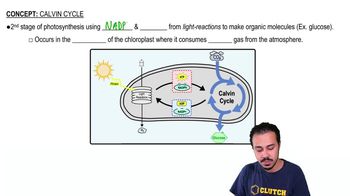
Understand the Calvin cycle: The Calvin cycle is a series of biochemical reactions that occur in the stroma of chloroplasts during photosynthesis. It is responsible for converting carbon dioxide (CO₂) into glucose using energy from ATP and NADPH produced in the light-dependent reactions.
Review the key processes of the Calvin cycle: The cycle involves three main stages: (1) Carbon fixation, where CO₂ is incorporated into a 5-carbon sugar (ribulose-1,5-bisphosphate or RuBP) by the enzyme RuBisCO; (2) Reduction, where ATP and NADPH are used to convert 3-phosphoglycerate (3-PGA) into glyceraldehyde-3-phosphate (G3P); and (3) Regeneration, where RuBP is regenerated using ATP to continue the cycle.
Analyze each option: (a) Carbon fixation is a key step in the Calvin cycle, so it does occur. (b) Oxidation of NADPH occurs during the reduction phase, where NADPH donates electrons to reduce 3-PGA into G3P. (c) Consumption of ATP occurs in both the reduction and regeneration phases. (d) Release of oxygen does not occur in the Calvin cycle; oxygen is released during the light-dependent reactions of photosynthesis, not the Calvin cycle.
Identify the correct answer: Based on the analysis, the process that does not occur during the Calvin cycle is the release of oxygen.
Conclude: The Calvin cycle is focused on carbon fixation and the synthesis of sugars, and it does not involve the release of oxygen, which is a separate process tied to the splitting of water molecules in the light-dependent reactions.

Verified video answer for a similar problem:

This video solution was recommended by our tutors as helpful for the problem above.
Video duration:
4m
Was this helpful?

Key Concepts

Here are the essential concepts you must grasp in order to answer the question correctly.

Calvin Cycle

The Calvin cycle is a series of biochemical reactions that occur in the stroma of chloroplasts during photosynthesis. It is responsible for converting carbon dioxide and other compounds into glucose, utilizing energy from ATP and reducing power from NADPH. The cycle consists of three main phases: carbon fixation, reduction, and regeneration of ribulose bisphosphate.
Recommended video:

Carbon Fixation

Carbon fixation is the initial step of the Calvin cycle, where carbon dioxide is incorporated into an organic molecule. This process is catalyzed by the enzyme ribulose bisphosphate carboxylase/oxygenase (RuBisCO), resulting in the formation of 3-phosphoglycerate (3-PGA). It is essential for converting inorganic carbon into a form that can be utilized by living organisms.
Recommended video:

Role of NADPH and ATP

NADPH and ATP are crucial energy carriers produced during the light-dependent reactions of photosynthesis. In the Calvin cycle, NADPH provides the reducing power needed to convert 3-PGA into glyceraldehyde-3-phosphate (G3P), while ATP supplies the energy required for various reactions. However, the Calvin cycle does not involve the oxidation of NADPH or the release of oxygen, which distinguishes it from the light-dependent reactions.
Recommended video:
Related Practice
Textbook Question

Which of the following are produced by reactions that take place in the thylakoids and consumed by reactions in the stroma?

a. CO₂ and H₂O

b. ATP and NADPH

c. ATP, NADPH, and CO₂

d. ATP, NADPH, and O₂

1299
views
Textbook Question

When light strikes chlorophyll molecules in the reaction-center complex, they lose electrons, which are ultimately replaced by

a. Splitting water

b. Oxidizing NADPH

c. The primary electron acceptor

d. The electron transport chain

1462
views
Textbook Question

The reactions of the Calvin cycle are not directly dependent on light, but they usually do not occur at night. Why? (Explain your answer.)

a. It is often too cold at night for these reactions to take place.

b. Carbon dioxide concentrations decrease at night.

c. The Calvin cycle depends on products of the light reactions.

d. Plants usually close their stomata at night.

1467
views
Textbook Question

Why is it difficult for C3 plants to carry out photosynthesis in very hot, dry environments such as deserts?

a. The light is too intense and destroys the pigment molecules.

b. The closing of stomata keeps CO₂ from entering and O₂ from leaving the plant.

c. They must rely on photorespiration to make ATP.

d. CO₂ builds up in the leaves, blocking carbon fixation.

1330
views
Textbook Question

How is photosynthesis similar in C4 plants and CAM plants?

a. In both cases, the light reactions and the Calvin cycle are separated in both time and location.

b. Both types of plants make sugar without the Calvin cycle.

c. In both cases, rubisco is not used to fix carbon initially.

d. Both types of plants make most of their sugar in the dark.

1310
views
Textbook Question

To synthesize one glucose molecule, the Calvin cycle uses _________ molecules of CO₂, _________ molecules of ATP, and _________ molecules of NADPH.

1626
views