
Pearson+ LogoPearson+ Logo
Ch. 31 Plant Structure, Growth, and Reproduction
Taylor - Campbell Biology: Concepts & Connections 10th Edition
Taylor, Simon, Dickey, Hogan10th EditionCampbell Biology: Concepts & ConnectionsISBN: 9780136538783Not the one you use?Change textbook
Chapter 31, Problem 13

Name two kinds of asexual reproduction among plants. Explain two advantages of asexual reproduction over sexual reproduction.
What is the primary drawback of asexual reproduction?

Verified step by step guidance
1
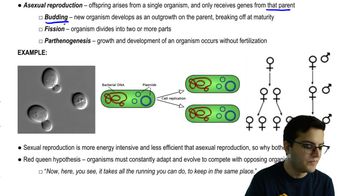
Identify two common types of asexual reproduction in plants: (1) vegetative propagation, where new plants grow from parts like stems, roots, or leaves (e.g., runners in strawberries or tubers in potatoes), and (2) budding, where a new organism develops from an outgrowth or bud on the parent plant (e.g., in some succulents).
Explain the first advantage of asexual reproduction: It allows plants to reproduce quickly without the need for pollinators or external factors, which is especially useful in stable environments where conditions are favorable for the parent plant.
Explain the second advantage of asexual reproduction: Offspring are genetically identical to the parent, ensuring that successful traits are preserved and passed on without variation.
Discuss the primary drawback of asexual reproduction: Since offspring are clones of the parent, there is no genetic diversity, which makes the population more vulnerable to diseases or environmental changes that could affect all individuals equally.
Summarize the trade-off: Asexual reproduction is efficient and reliable in stable environments but lacks the genetic variation that sexual reproduction provides, which is crucial for adaptation and survival in changing conditions.

Verified video answer for a similar problem:

This video solution was recommended by our tutors as helpful for the problem above.
Video duration:
1m
Was this helpful?

Key Concepts

Here are the essential concepts you must grasp in order to answer the question correctly.

Asexual Reproduction in Plants

Asexual reproduction in plants involves the production of offspring without the fusion of gametes. Common methods include vegetative propagation, where new plants grow from parts of the parent plant, such as roots, stems, or leaves. Examples include runners in strawberries and tubers in potatoes. This method allows for rapid population increase and the maintenance of genetic uniformity.
Recommended video:
Guided course
05:44
Sexual and Asexual Reproduction

Advantages of Asexual Reproduction

Asexual reproduction offers several advantages over sexual reproduction. Firstly, it allows for quicker reproduction since it does not require the time and energy for finding a mate or pollination. Secondly, it ensures that successful genetic traits are preserved in offspring, as they are clones of the parent, which can be beneficial in stable environments where those traits are advantageous.
Recommended video:
Guided course
05:44
Sexual and Asexual Reproduction

Drawbacks of Asexual Reproduction

The primary drawback of asexual reproduction is the lack of genetic diversity among offspring. Since all offspring are clones of the parent, they are equally susceptible to diseases and environmental changes. This homogeneity can lead to population vulnerability, as a single threat could potentially wipe out the entire population, unlike sexually reproduced populations that may have varied traits to adapt to challenges.
Recommended video:
Guided course
05:44
Sexual and Asexual Reproduction