
Pearson+ LogoPearson+ Logo
Ch. 31 Plant Structure, Growth, and Reproduction
Taylor - Campbell Biology: Concepts & Connections 10th Edition
Taylor, Simon, Dickey, Hogan10th EditionCampbell Biology: Concepts & ConnectionsISBN: 9780136538783Not the one you use?Change textbook
Chapter 31, Problem 10

While walking in the woods, you encounter an unfamiliar nonwoody flowering plant. If you want to know whether it is a monocot or eudicot, it would not help to look at the
a. Number of seed leaves, or cotyledons, present in its seeds
b. Shape of its root system
c. Arrangement of vascular bundles in its stem
d. Size of the plant

Verified step by step guidance
1
Step 1: Understand the key differences between monocots and eudicots. Monocots and eudicots are two major groups of flowering plants (angiosperms) that differ in several structural features. Monocots typically have one cotyledon (seed leaf), parallel leaf venation, scattered vascular bundles in the stem, and a fibrous root system. Eudicots, on the other hand, have two cotyledons, net-like leaf venation, vascular bundles arranged in a ring in the stem, and a taproot system.
Step 2: Analyze the options provided in the question. The goal is to determine which characteristic would not help differentiate between a monocot and a eudicot. The options include: (a) number of seed leaves (cotyledons), (b) shape of the root system, (c) arrangement of vascular bundles in the stem, and (d) size of the plant.
Step 3: Evaluate each option. Option (a) is relevant because monocots have one cotyledon, while eudicots have two. Option (b) is relevant because monocots typically have a fibrous root system, while eudicots have a taproot system. Option (c) is relevant because monocots have scattered vascular bundles, while eudicots have vascular bundles arranged in a ring. Option (d), however, is not relevant because the size of the plant does not directly correlate with whether it is a monocot or eudicot.
Step 4: Conclude that the size of the plant (option d) would not help in determining whether the plant is a monocot or eudicot. This is because plant size is influenced by environmental factors and growth conditions, not by the monocot or eudicot classification.
Step 5: To confirm your understanding, review the structural differences between monocots and eudicots and how they can be used to identify plants in the field. This will help reinforce the reasoning behind why size is not a distinguishing characteristic.

Verified video answer for a similar problem:

This video solution was recommended by our tutors as helpful for the problem above.
Video duration:
2m
Was this helpful?

Key Concepts

Here are the essential concepts you must grasp in order to answer the question correctly.

Monocots vs. Eudicots

Monocots and eudicots are two major groups of flowering plants (angiosperms) distinguished primarily by the number of cotyledons, or seed leaves, they possess. Monocots have one cotyledon, while eudicots have two. This distinction is fundamental in plant classification and can help identify the plant's characteristics and evolutionary relationships.
Recommended video:
Guided course
03:39
Dominant vs. Recessive Alleles

Vascular Bundles

Vascular bundles are the arrangements of xylem and phloem in plants, crucial for transporting water, nutrients, and food. In monocots, vascular bundles are typically scattered throughout the stem, whereas in eudicots, they are arranged in a ring. Understanding this arrangement aids in distinguishing between these two plant groups.
Recommended video:
Guided course
06:08
Seedless Vascular Plants

Root System Types

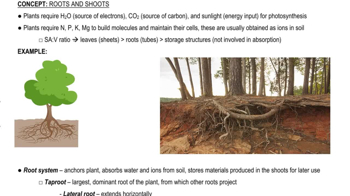
The root system of a plant can be classified into two main types: fibrous and taproot systems. Monocots usually exhibit a fibrous root system, while eudicots often have a taproot system. However, the root system alone is not a reliable indicator for distinguishing between monocots and eudicots, as variations can occur.
Recommended video: