Pearson+ LogoPearson+ Logo
Ch. 8 The Cellular Basis of Reproduction and Inheritance
Taylor - Campbell Biology: Concepts & Connections 10th Edition
Taylor, Simon, Dickey, Hogan10th EditionCampbell Biology: Concepts & ConnectionsISBN: 9780136538783Not the one you use?Change textbook
Chapter 8, Problem 19

Bacteria are able to divide on a faster schedule than eukaryotic cells. Some bacteria can divide every 20 minutes, while the minimum time required by eukaryotic cells in a rapidly developing embryo is about once per hour, and most cells divide much less often than that. State at least two testable hypotheses explaining why bacteria can divide at a faster rate than eukaryotic cells.

Verified step by step guidance
1
Understand the problem: The question asks for testable hypotheses explaining why bacteria can divide faster than eukaryotic cells. This requires knowledge of cellular biology, including differences in structure, complexity, and processes between prokaryotic (bacteria) and eukaryotic cells.
Step 1: Hypothesis 1 - Bacteria have a simpler cellular structure compared to eukaryotic cells. Bacteria lack membrane-bound organelles such as a nucleus, which allows them to replicate their DNA and divide more quickly. This hypothesis can be tested by comparing the time required for DNA replication and cell division in prokaryotic and eukaryotic cells under controlled conditions.
Step 2: Hypothesis 2 - Bacteria have smaller genomes compared to eukaryotic cells. A smaller genome size means less DNA to replicate, which could contribute to their faster division rate. This hypothesis can be tested by measuring the genome size of bacteria and eukaryotic cells and correlating it with their division times.
Step 3: Hypothesis 3 - Bacteria are unicellular organisms, and their division is primarily for reproduction, whereas eukaryotic cells often divide as part of a multicellular organism's growth or repair processes. This difference in purpose may influence the speed of division. This hypothesis can be tested by comparing division rates in unicellular eukaryotes versus multicellular eukaryotes.
Step 4: Hypothesis 4 - Bacteria have evolved to thrive in environments where rapid reproduction is advantageous for survival, such as nutrient-rich conditions. This evolutionary pressure may have selected for faster division rates. This hypothesis can be tested by studying bacterial division rates in different environmental conditions and comparing them to eukaryotic cells in similar conditions.

Verified video answer for a similar problem:

This video solution was recommended by our tutors as helpful for the problem above.
Video duration:
2m
Was this helpful?

Key Concepts

Here are the essential concepts you must grasp in order to answer the question correctly.

Cell Division Mechanisms

Cell division occurs through two primary processes: mitosis in eukaryotic cells and binary fission in bacteria. Mitosis is a complex process involving multiple stages and checkpoints to ensure accurate DNA replication and distribution, which can take considerable time. In contrast, binary fission is a simpler and faster process where a bacterium duplicates its DNA and splits into two identical cells, allowing for rapid population growth.
Recommended video:
Guided course
03:19
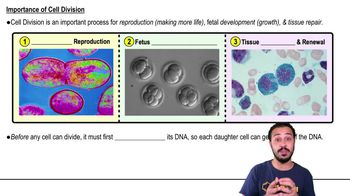
Importance of Cell Division

Cell Size and Complexity

Bacteria are generally smaller and less complex than eukaryotic cells, which allows them to divide more quickly. The smaller size means that bacteria have less cellular material to replicate and distribute during division. Eukaryotic cells, with their larger size and more complex structures, require more time to prepare for and complete the division process.
Recommended video:
06:15
Origin of Complex Traits

Nutrient Availability and Environmental Factors

The rate of cell division in bacteria can be influenced by nutrient availability and environmental conditions. Bacteria can rapidly adapt to favorable conditions, such as abundant nutrients, which can trigger faster division rates. In contrast, eukaryotic cells often have more stringent requirements for growth and division, including specific signals and conditions that must be met, leading to slower division rates.
Recommended video:
Guided course
03:25
Soil Nutrients
Related Practice
Textbook Question

Compare cytokinesis in plant and animal cells.

In what ways are the two processes similar?

In what ways are they different?

2238
views
Textbook Question

Sketch a cell with three pairs of chromosomes undergoing meiosis, and show how non-disjunction can result in the production of gametes with extra or missing chromosomes.

2241
views
Textbook Question

Suppose you read in the newspaper that a genetic engineering laboratory has developed a procedure for fusing two gametes from the same person (two eggs or two sperm) to form a zygote. The article mentions that an early step in the procedure prevents crossing over from occurring during the formation of the gametes in the donor's body. The researchers are in the process of determining the genetic makeup of one of their new zygotes. Which of the following predictions do you think they would make? Justify your choice, and explain why you rejected each of the other choices.

a. The zygote would have 46 chromosomes, all of which came from the gamete donor (its one parent), so the zygote would be genetically identical to the gamete donor.

b. The zygote could be genetically identical to the gamete donor, but it is much more likely that it would have an unpredictable mixture of chromosomes from the gamete donor's parents.

c. The zygote would not be genetically identical to the gamete donor, but it would be genetically identical to one of the donor's parents.

d. The zygote would not be genetically identical to the gamete donor, but it would be genetically identical to one of the donor's grandparents.

1053
views
Textbook Question

Red blood cells, which carry oxygen to body tissues, live for only about 120 days. Replacement cells are produced by cell division in bone marrow.

How many cell divisions must occur each second in your bone marrow just to replace red blood cells? Here is some information to use in calculating your answer: There are about 5 million red blood cells per cubic millimeter (mm³) of blood. An average adult has about 5 L (5,000 cm³) of blood. (Hint: What is the total number of red blood cells in the body?

What fraction of them must be replaced each day if all are replaced in 120 days?

2299
views
Textbook Question
A mule is the offspring of a horse and a donkey. A donkey sperm contains 31 chromosomes and a horse egg cell contains 32 chromosomes, so the zygote contains a total of 63 chromosomes. The zygote develops normally. The combined set of chromosomes is not a problem in mitosis, and the mule combines some of the best characteristics of horses and donkeys. However, a mule is sterile; meiosis cannot occur normally in its testes (or ovaries). Explain why mitosis is normal in cells containing both horse and donkey chromosomes but the mixed set of chromosomes interferes with meiosis.
3730
views
Textbook Question

What you think of as 'a banana' is a Cavendish, one variety of the species Musa acuminate. It is a triploid organism (3n) with three sets of chromosomes in every somatic cell. The Cavendish cannot be naturally bred; it can only be reproduced by cloning. Explain how its triploid state accounts for its inability to form normal gametes. Discuss how the lack of sexual reproduction might make the species particularly vulnerable to a new pest.

1590
views