Textbook Question
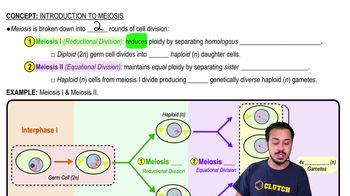
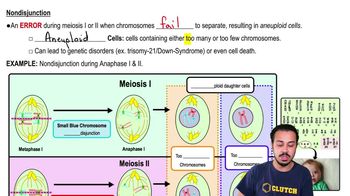
Briefly describe how three different processes that occur during a sexual life cycle increase the genetic diversity of offspring.
1524
views



 Taylor, Simon, Dickey, Hogan 10th EditionCh. 8 The Cellular Basis of Reproduction and InheritanceProblem 17
 Verified step by step guidance
 04:49
04:49
 05:03 05:03
Discuss the factors that control the division of eukaryotic cells grown in the laboratory. Cancer cells are easier to grow in the lab than other cells.
Why do you suppose this is?
Compare cytokinesis in plant and animal cells.
In what ways are the two processes similar?
In what ways are they different?
Suppose you read in the newspaper that a genetic engineering laboratory has developed a procedure for fusing two gametes from the same person (two eggs or two sperm) to form a zygote. The article mentions that an early step in the procedure prevents crossing over from occurring during the formation of the gametes in the donor's body. The researchers are in the process of determining the genetic makeup of one of their new zygotes. Which of the following predictions do you think they would make? Justify your choice, and explain why you rejected each of the other choices.
a. The zygote would have 46 chromosomes, all of which came from the gamete donor (its one parent), so the zygote would be genetically identical to the gamete donor.
b. The zygote could be genetically identical to the gamete donor, but it is much more likely that it would have an unpredictable mixture of chromosomes from the gamete donor's parents.
c. The zygote would not be genetically identical to the gamete donor, but it would be genetically identical to one of the donor's parents.
d. The zygote would not be genetically identical to the gamete donor, but it would be genetically identical to one of the donor's grandparents.
Bacteria are able to divide on a faster schedule than eukaryotic cells. Some bacteria can divide every 20 minutes, while the minimum time required by eukaryotic cells in a rapidly developing embryo is about once per hour, and most cells divide much less often than that. State at least two testable hypotheses explaining why bacteria can divide at a faster rate than eukaryotic cells.
Red blood cells, which carry oxygen to body tissues, live for only about 120 days. Replacement cells are produced by cell division in bone marrow.
How many cell divisions must occur each second in your bone marrow just to replace red blood cells? Here is some information to use in calculating your answer: There are about 5 million red blood cells per cubic millimeter (mm³) of blood. An average adult has about 5 L (5,000 cm³) of blood. (Hint: What is the total number of red blood cells in the body?
What fraction of them must be replaced each day if all are replaced in 120 days?