
Pearson+ LogoPearson+ Logo
Ch. 8 The Cellular Basis of Reproduction and Inheritance
Taylor - Campbell Biology: Concepts & Connections 10th Edition
Taylor, Simon, Dickey, Hogan10th EditionCampbell Biology: Concepts & ConnectionsISBN: 9780136538783Not the one you use?Change textbook
Chapter 8, Problem 14

Briefly describe how three different processes that occur during a sexual life cycle increase the genetic diversity of offspring.

Verified step by step guidance
1
Identify the three key processes in sexual reproduction that contribute to genetic diversity: independent assortment of chromosomes, crossing over, and random fertilization.
Explain independent assortment of chromosomes, which occurs during meiosis I. Describe how the maternal and paternal chromosomes are randomly distributed into gametes, leading to a variety of possible genetic combinations.
Discuss crossing over, a process that occurs during prophase I of meiosis. Outline how homologous chromosomes exchange genetic material, creating new combinations of genes that are different from those carried by the parent chromosomes.
Describe random fertilization and how the fusion of any sperm with any egg increases genetic variability. Each gamete carries a unique genetic makeup, and the combination of these unique gametes results in offspring with a genetic identity distinct from that of their parents and siblings.
Summarize how these processes—each contributing to the shuffling and recombination of genetic material—result in offspring with increased genetic diversity, which is crucial for the survival and adaptation of species in changing environments.

Verified video answer for a similar problem:

This video solution was recommended by our tutors as helpful for the problem above.
Video duration:
1m
Was this helpful?

Key Concepts

Here are the essential concepts you must grasp in order to answer the question correctly.

Meiosis

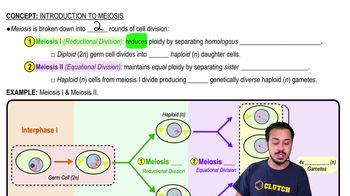
Meiosis is a specialized form of cell division that reduces the chromosome number by half, resulting in the formation of gametes (sperm and eggs). During meiosis, genetic recombination occurs through processes like crossing over, where homologous chromosomes exchange genetic material. This shuffling of genes contributes to genetic diversity in offspring, as each gamete carries a unique combination of alleles.
Recommended video:
Guided course
04:49
Meiosis I & Meiosis II

Fertilization

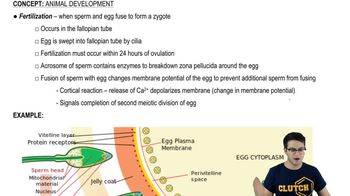
Fertilization is the process where male and female gametes unite to form a zygote. This event combines genetic material from two parents, introducing new allele combinations into the offspring. The random nature of which sperm fertilizes which egg further enhances genetic diversity, as each fertilization event can produce a genetically distinct zygote.
Recommended video:
Guided course
01:59
Fertilization

Independent Assortment

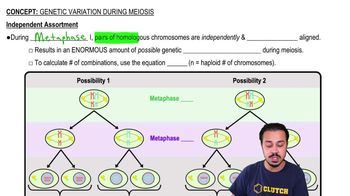
Independent assortment refers to the random distribution of maternal and paternal chromosomes into gametes during meiosis. This principle states that the segregation of one pair of alleles is independent of the segregation of another pair, leading to a variety of genetic combinations. As a result, offspring inherit a mix of traits from both parents, significantly increasing genetic variation within a population.
Recommended video:
Guided course
08:49
Independent Assortment