

Pearson+ LogoPearson+ Logo
Ch. 29 The Senses
Taylor - Campbell Biology: Concepts & Connections 10th Edition
Taylor, Simon, Dickey, Hogan10th EditionCampbell Biology: Concepts & ConnectionsISBN: 9780136538783Not the one you use?Change textbook
Chapter 29, Problem 1

Complete this concept map summarizing sensory receptors. Concept map summarizing sensory receptors in biology, chapter 46.

Verified step by step guidance
1
Identify the four main types of sensory receptors: mechanoreceptors, chemoreceptors, pain and thermoreceptors, and electromagnetic receptors.
Determine the functions of each type of receptor: mechanoreceptors (touch, hearing, balance), chemoreceptors (taste and smell), pain and thermoreceptors (detect pain and temperature changes), and electromagnetic receptors (sensitive to light, magnetic fields, etc.).
Match the functions to the appropriate sensory receptor types: mechanoreceptors are involved in touch, hearing, and balance; chemoreceptors are involved in taste and smell.
Identify the specific types of mechanoreceptors and electromagnetic receptors: mechanoreceptors include hair cells (f), and electromagnetic receptors in the eye include rods and cones (g).
Fill in the missing labels in the concept map: (a) mechanoreceptors, (b) chemoreceptors, (c) light, (d) magnetic fields, (e) electric fields, (f) hair cells, (g) rods and cones.

Verified video answer for a similar problem:

This video solution was recommended by our tutors as helpful for the problem above.
Video duration:
2m
Was this helpful?

Key Concepts

Here are the essential concepts you must grasp in order to answer the question correctly.

Sensory Receptors

Sensory receptors are specialized cells that detect and respond to specific types of stimuli from the environment, such as light, sound, and touch. They convert these stimuli into electrical signals that can be interpreted by the nervous system, allowing organisms to perceive their surroundings and react accordingly.
Recommended video:
Guided course
02:54
Sensory Receptors

Types of Sensory Receptors

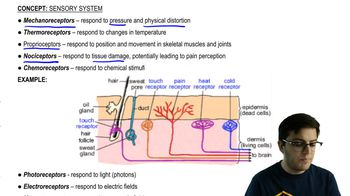
Sensory receptors are categorized into various types based on the stimuli they respond to. For example, mechanoreceptors respond to mechanical pressure or distortion, thermoreceptors detect temperature changes, and photoreceptors are sensitive to light. This classification helps in understanding how different senses function and interact with the environment.
Recommended video:
Guided course
02:54
Sensory Receptors

Location and Function

The location of sensory receptors is crucial for their function. For instance, mechanoreceptors are found in the skin and are involved in touch and pressure sensation, while photoreceptors are located in the retina of the eye, enabling vision. Understanding where these receptors are situated helps in comprehending how sensory information is processed and perceived.
Recommended video:
Guided course
06:04
Functional Groups