Pearson+ LogoPearson+ Logo
Ch. 29 The Senses
Taylor - Campbell Biology: Concepts & Connections 10th Edition
Taylor, Simon, Dickey, Hogan10th EditionCampbell Biology: Concepts & ConnectionsISBN: 9780136538783Not the one you use?Change textbook
Chapter 29, Problem 4

What do the receptor cells in the lateral line system along the sides of a shark and the cochlea of your ear have in common?
a. They use hair cells to sense sound or pressure waves.
b. They are organs of equilibrium.
c. They use electromagnetic receptors to sense pressure waves in fluid.
d. They use granules that signal a change in position and stimulate their receptor cells.

Verified step by step guidance
1
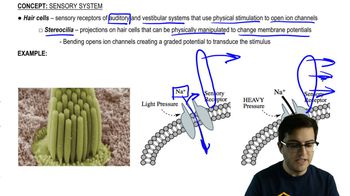
Step 1: Begin by understanding the lateral line system in sharks. The lateral line system is a sensory organ that detects pressure changes and vibrations in water, helping the shark sense movement and locate prey. It uses specialized receptor cells called hair cells.
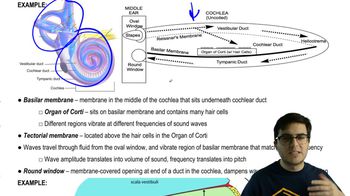
Step 2: Next, examine the cochlea in the human ear. The cochlea is a spiral-shaped organ responsible for detecting sound waves. It contains hair cells that convert sound vibrations into electrical signals for the brain to interpret.
Step 3: Compare the receptor cells in both systems. Both the lateral line system and the cochlea rely on hair cells to sense mechanical stimuli, such as pressure waves or sound vibrations, making this a shared characteristic.
Step 4: Eliminate incorrect answer choices by analyzing their descriptions. For example, electromagnetic receptors are not involved in sensing pressure waves, and granules signaling positional changes are related to equilibrium organs, not the lateral line or cochlea.
Step 5: Conclude that the correct answer is the option describing the use of hair cells to sense sound or pressure waves, as this is the common feature between the lateral line system and the cochlea.

Verified video answer for a similar problem:

This video solution was recommended by our tutors as helpful for the problem above.
Video duration:
1m
Was this helpful?

Key Concepts

Here are the essential concepts you must grasp in order to answer the question correctly.

Hair Cells

Hair cells are specialized sensory cells found in various organisms, including sharks and humans. They are equipped with tiny hair-like structures called stereocilia that detect mechanical stimuli, such as sound or pressure waves. In both the lateral line system of sharks and the cochlea of the human ear, hair cells play a crucial role in converting these mechanical signals into electrical impulses that the nervous system can interpret.
Recommended video:

Lateral Line System

The lateral line system is a sensory organ found in aquatic animals, including sharks, that detects water movements and vibrations. It consists of a series of mechanoreceptors, including hair cells, arranged in a line along the sides of the body. This system allows sharks to sense changes in their environment, such as the presence of prey or predators, by responding to pressure waves in the water.
Recommended video:
Guided course
09:19
Immune System

Cochlea

The cochlea is a spiral-shaped organ in the inner ear of mammals, including humans, responsible for hearing. It contains hair cells that respond to sound waves transmitted through the fluid-filled structure. As sound waves enter the cochlea, they create pressure changes that stimulate the hair cells, leading to the conversion of sound into neural signals that the brain interprets as sound perception.
Recommended video:
Related Practice
Textbook Question
Complete this concept map summarizing sensory receptors.

2025
views
Textbook Question

Which of the following sensory receptors is incorrectly paired with its category?

a. Hair cell . . . Mechanoreceptor

b. Taste receptor . . . Chemoreceptor

c. Rod . . . Electromagnetic receptor

d. Olfactory receptor . . . Electromagnetic receptor

1073
views
Textbook Question

Which of the following are not known to be present in human skin?

a. Thermoreceptors

b. Electromagnetic receptors

c. Pressure receptors

d. Pain receptors

1126
views
Textbook Question

If you look away from this book and focus your eyes on a distant object, the eye muscles _________ and the lenses _________ to focus images on the retinas.

a. Relax . . . Flatten

b. Relax . . . Become more rounded

c. Contract . . . Flatten

d. Contract . . . Become more rounded

834
views
Textbook Question
How does your brain determine the volume and pitch of sounds?
1458
views
Textbook Question

Eighty-year-old Mr. Johnson was becoming slightly deaf. To test his hearing, his doctor held a vibrating tuning fork tightly against the back of Mr. Johnson's skull. This sent vibrations through the bones of the skull, setting the fluid in the cochlea in motion. Mr. Johnson could hear the tuning fork this way, but not when it was held away from the skull a few inches from his ear. The problem was probably in the _________ . (Explain your answer.)

a. Auditory nerve leading to the brain

b. Hair cells in the cochlea

c. Bones of the middle ear

d. Fluid of the cochlea

754
views