

Pearson+ LogoPearson+ Logo
Ch. 29 The Senses
Taylor - Campbell Biology: Concepts & Connections 10th Edition
Taylor, Simon, Dickey, Hogan10th EditionCampbell Biology: Concepts & ConnectionsISBN: 9780136538783Not the one you use?Change textbook
Chapter 29, Problem 7

Eighty-year-old Mr. Johnson was becoming slightly deaf. To test his hearing, his doctor held a vibrating tuning fork tightly against the back of Mr. Johnson's skull. This sent vibrations through the bones of the skull, setting the fluid in the cochlea in motion. Mr. Johnson could hear the tuning fork this way, but not when it was held away from the skull a few inches from his ear. The problem was probably in the _________ . (Explain your answer.)
a. Auditory nerve leading to the brain
b. Hair cells in the cochlea
c. Bones of the middle ear
d. Fluid of the cochlea

Verified step by step guidance
1
Step 1: Understand the context of the problem. The doctor is testing Mr. Johnson's hearing using a tuning fork. When the tuning fork is placed against the skull, the vibrations travel through the bones of the skull to the cochlea, allowing Mr. Johnson to hear. However, he cannot hear the tuning fork when it is held away from the skull, indicating a specific type of hearing issue.
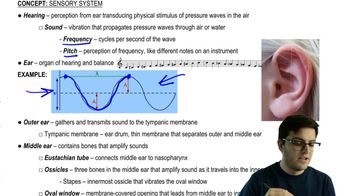
Step 2: Review the anatomy and physiology of the ear. Sound waves normally travel through the outer ear, vibrate the eardrum, and are transmitted via the bones of the middle ear (malleus, incus, and stapes) to the cochlea. The cochlea contains fluid and hair cells that convert these vibrations into nerve signals, which are then transmitted to the brain via the auditory nerve.
Step 3: Analyze the results of the test. Since Mr. Johnson can hear the tuning fork through bone conduction (vibrations directly reaching the cochlea) but not through air conduction (sound waves traveling through the outer and middle ear), this suggests that the problem lies in the structures responsible for air conduction.
Step 4: Eliminate incorrect options. (a) The auditory nerve is functioning because Mr. Johnson can hear through bone conduction. (b) The hair cells in the cochlea are functioning because they are able to detect vibrations from the skull. (d) The fluid in the cochlea is also functioning properly since it is involved in transmitting vibrations to the hair cells.
Step 5: Identify the correct answer. The issue is likely with (c) the bones of the middle ear, as they are responsible for transmitting sound from the eardrum to the cochlea during air conduction. A problem with these bones (e.g., stiffness or damage) could prevent sound from being transmitted effectively, leading to the observed symptoms.

Verified video answer for a similar problem:

This video solution was recommended by our tutors as helpful for the problem above.
Video duration:
1m
Was this helpful?

Key Concepts

Here are the essential concepts you must grasp in order to answer the question correctly.

Conductive Hearing Loss

Conductive hearing loss occurs when sound waves are not effectively conducted through the outer ear, tympanic membrane, or middle ear structures. In Mr. Johnson's case, the ability to hear the tuning fork when it is placed against the skull suggests that the inner ear and auditory nerve are functioning, indicating a potential issue with the middle ear structures, such as the bones that transmit sound.
Recommended video:

Cochlea and Fluid Dynamics

The cochlea is a spiral-shaped organ in the inner ear filled with fluid that plays a crucial role in hearing. When sound vibrations reach the cochlea, they cause the fluid to move, stimulating hair cells that convert these mechanical signals into electrical impulses sent to the brain. If Mr. Johnson can hear the tuning fork through bone conduction, it implies that the cochlea and its fluid are likely functioning properly.
Recommended video:
Guided course
03:37
Disturbances Make Communities Dynamic

Bone Conduction vs. Air Conduction

Bone conduction refers to the transmission of sound vibrations through the bones of the skull directly to the inner ear, bypassing the outer and middle ear. In contrast, air conduction involves sound traveling through the air and entering the ear canal. Mr. Johnson's ability to hear the tuning fork when it is placed against his skull but not when held away suggests a problem with air conduction, likely indicating an issue with the middle ear structures.
Recommended video:
Guided course
07:05
Myelin and Saltatory Conduction
Related Practice
Textbook Question

What do the receptor cells in the lateral line system along the sides of a shark and the cochlea of your ear have in common?

a. They use hair cells to sense sound or pressure waves.

b. They are organs of equilibrium.

c. They use electromagnetic receptors to sense pressure waves in fluid.

d. They use granules that signal a change in position and stimulate their receptor cells.

1381
views
Textbook Question

If you look away from this book and focus your eyes on a distant object, the eye muscles _________ and the lenses _________ to focus images on the retinas.

a. Relax . . . Flatten

b. Relax . . . Become more rounded

c. Contract . . . Flatten

d. Contract . . . Become more rounded

834
views
Textbook Question
How does your brain determine the volume and pitch of sounds?
1458
views
Textbook Question
When you first sit down to read in a coffee shop, the surroundings seem very loud. Yet after a few minutes reading you realize you hardly notice the noise at all. Why is that?
771
views
Textbook Question
Hold your right eye closed. With your left eye, look at the + in the image below. Starting from about two feet away, slowly bring your head closer while looking at the +. What happens to the dot when you get close to the image? What property of the eye's structure does this exercise demonstrate?

659
views
Textbook Question
Construct a graph in which membrane potential is on the y axis and time is on the x axis. Then draw the action potentials that occur when a bitter flavor is absent, followed by the action potentials that result when a person tastes a bitter flavor.
872
views