Pearson+ LogoPearson+ Logo
Ch. 16 - How Genes Work
Freeman - Biological Science 7th Edition
Freeman7th EditionBiological ScienceISBN: 9783584863285Not the one you use?Change textbook
Chapter 16, Problem 6

For each of these statements about the genetic code, select True or False.a. T/F Wobble pairing accounts for the redundancy of the genetic code.b. T/F There are 64 different tRNAs that read the 64 possible codons.c. T/F All possible codons are used, but not all codons specify an amino acid.d. T/F Some codons are recognized by proteins, not by tRNAs.

Verified step by step guidance
1
Identify the concept of wobble pairing and understand how it relates to the redundancy of the genetic code. Wobble pairing allows a single tRNA to recognize multiple codons, thus contributing to the redundancy where several codons can code for the same amino acid.
Review the structure and function of tRNA molecules. Consider the fact that although there are 64 codons, not all of them require a unique tRNA due to the wobble base pairing at the third position of the codon.
Examine the genetic code chart to determine if all 64 codons are used and what they specify. Note that while all codons are indeed utilized in the genetic code, three of these codons function as stop signals and do not code for any amino acid.
Understand the role of tRNAs in the translation process and evaluate the statement regarding codons being recognized by proteins. Recall that during translation, codons in mRNA are recognized by tRNAs, not proteins, although proteins are involved in other aspects of translation regulation and facilitation.
Summarize the findings from each statement analysis to determine the truth value based on the biological principles and functions discussed.

Verified video answer for a similar problem:

This video solution was recommended by our tutors as helpful for the problem above.
Video duration:
2m
Was this helpful?

Key Concepts

Here are the essential concepts you must grasp in order to answer the question correctly.

Wobble Pairing

Wobble pairing refers to the flexibility in base pairing between the third base of a codon and the corresponding base of the anticodon in tRNA. This phenomenon allows a single tRNA to recognize multiple codons that code for the same amino acid, contributing to the redundancy of the genetic code. This flexibility helps to minimize the impact of mutations and ensures efficient protein synthesis.
Recommended video:
Guided course
08:09
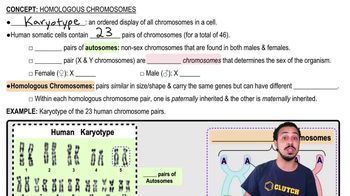
Homologous Chromosomes

Codons and tRNAs

Codons are sequences of three nucleotides in mRNA that specify particular amino acids during protein synthesis. There are 64 possible codons, but not all of them correspond to unique tRNAs; in fact, there are fewer than 64 distinct tRNAs due to wobble pairing. This means that some tRNAs can pair with more than one codon, which is essential for the efficiency of translation.
Recommended video:
Guided course
06:16
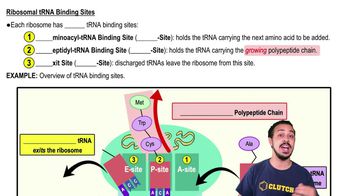
Ribosomal tRNA Binding Sites

Codon Usage

Codon usage refers to the frequency with which different codons are used to encode the same amino acid in a given organism. While all 64 codons exist, not all are utilized in every organism, and some codons may not specify an amino acid at all, such as stop codons. Understanding codon usage is important for comprehending how genetic information is translated into proteins and how variations can affect gene expression.
Recommended video:
Guided course
11:39
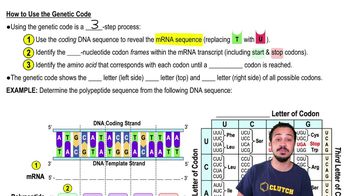
How to Use the Genetic Code
Related Practice
Textbook Question
A friend says, 'Geneticists spend all their time talking about DNA, but that's silly because DNA really isn't that important in the functions of a cell.' In what ways is she right, and in what ways might she be wrong?
1265
views
Textbook Question

A minimal genetic code requires only 21 codons—one for each amino acid, and one for a stop signal. Given this, what advantage might be offered by having a code with 64 codons?

986
views
Textbook Question
A minimal genetic code requires only 21 codons—one for each amino acid, and one for a stop signal. Given this, what advantage might be offered by having a code with 64 codons?
3653
views
Textbook Question
Imagine discovering a loss-of-function mutation in a eukaryotic gene. You determine the gene's nucleotide sequence from the start site for transcription to the termination point of transcription and find no differences from the wild-type sequence. Explain where you think the mutation might be and how the mutation might be acting.
946
views
Textbook Question

Which of the following describes mutations? Select True or False for each statement.

T/F Point mutations can occur in any DNA sequence.

T/F Frameshift mutations can occur in any DNA sequence.

T/F Neutral mutations depend on the degeneracy of the genetic code.

T/F Deleterious mutations occur only in protein-coding sequences of DNA.

810
views
Textbook Question
Which of the following describes mutations? Select True or False for each statement.T/F Point mutations can occur in any DNA sequence.T/F Frameshift mutations can occur in any DNA sequence.T/F Neutral mutations depend on the degeneracy of the genetic code.T/F Deleterious mutations occur only in protein-coding sequences of DNA.
1579
views