Pearson+ LogoPearson+ Logo
Ch. 16 - How Genes Work
Freeman - Biological Science 7th Edition
Freeman7th EditionBiological ScienceISBN: 9783584863285Not the one you use?Change textbook
Chapter 16, Problem 6

Imagine discovering a loss-of-function mutation in a eukaryotic gene. You determine the gene's nucleotide sequence from the start site for transcription to the termination point of transcription and find no differences from the wild-type sequence. Explain where you think the mutation might be and how the mutation might be acting.

Verified step by step guidance
1
Identify potential regions outside the coding sequence that could be affected by the mutation. These include promoter regions, enhancers, silencers, and other regulatory elements that control the gene's expression.
Consider the possibility of mutations in the introns or untranslated regions (UTRs) of the gene. These areas, while not coding for the protein directly, can influence splicing, mRNA stability, and translation efficiency.
Explore the potential for epigenetic changes that could lead to a loss-of-function mutation. This includes methylation of DNA, modification of histones, or changes in chromatin structure that could affect gene expression without altering the nucleotide sequence.
Investigate the impact of the mutation on the mRNA transcript. Even if the nucleotide sequence is unchanged, alterations in mRNA processing, transport, or localization could lead to a loss of function.
Examine the possibility of mutations in other genes that interact with or regulate the gene in question. These could indirectly cause a loss of function in the gene of interest through changes in the cellular environment or signaling pathways.

Verified video answer for a similar problem:

This video solution was recommended by our tutors as helpful for the problem above.
Video duration:
3m
Was this helpful?

Key Concepts

Here are the essential concepts you must grasp in order to answer the question correctly.

Loss-of-Function Mutation

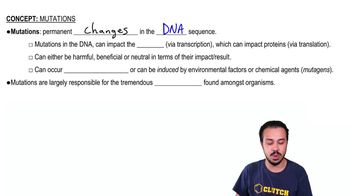
A loss-of-function mutation is a genetic alteration that results in reduced or abolished gene function. This type of mutation can occur in various forms, such as point mutations, deletions, or insertions, which may affect the protein's structure or stability. Understanding this concept is crucial for analyzing how mutations can disrupt normal biological processes and lead to phenotypic changes.
Recommended video:

Gene Regulation

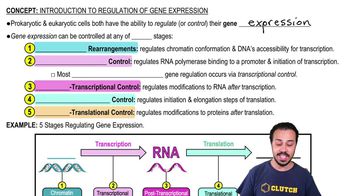
Gene regulation refers to the mechanisms that control the expression of genes, determining when and how much of a gene product is made. This includes transcription factors, enhancers, and silencers that can influence the transcription process. A mutation may not alter the nucleotide sequence of the gene itself but could affect regulatory elements, leading to a loss of function despite the wild-type sequence being intact.
Recommended video:
Guided course
06:40
Introduction to Regulation of Gene Expression

Transcription and Translation

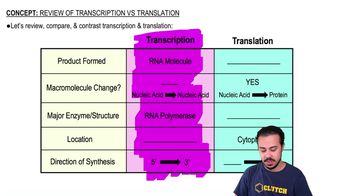
Transcription is the process by which the DNA sequence of a gene is copied into messenger RNA (mRNA), while translation is the subsequent process where mRNA is decoded to synthesize proteins. Understanding these processes is essential for identifying how mutations can impact gene expression and protein synthesis, potentially leading to a loss of function even when the coding sequence appears normal.
Recommended video:
Guided course
04:07
Review of Transcription vs. Translation
Related Practice
Textbook Question

A minimal genetic code requires only 21 codons—one for each amino acid, and one for a stop signal. Given this, what advantage might be offered by having a code with 64 codons?

986
views
Textbook Question
A minimal genetic code requires only 21 codons—one for each amino acid, and one for a stop signal. Given this, what advantage might be offered by having a code with 64 codons?
3653
views
Textbook Question
For each of these statements about the genetic code, select True or False.a. T/F Wobble pairing accounts for the redundancy of the genetic code.b. T/F There are 64 different tRNAs that read the 64 possible codons.c. T/F All possible codons are used, but not all codons specify an amino acid.d. T/F Some codons are recognized by proteins, not by tRNAs.
1278
views
1
rank
Textbook Question

Which of the following describes mutations? Select True or False for each statement.

T/F Point mutations can occur in any DNA sequence.

T/F Frameshift mutations can occur in any DNA sequence.

T/F Neutral mutations depend on the degeneracy of the genetic code.

T/F Deleterious mutations occur only in protein-coding sequences of DNA.

810
views
Textbook Question
Which of the following describes mutations? Select True or False for each statement.T/F Point mutations can occur in any DNA sequence.T/F Frameshift mutations can occur in any DNA sequence.T/F Neutral mutations depend on the degeneracy of the genetic code.T/F Deleterious mutations occur only in protein-coding sequences of DNA.
1579
views
Textbook Question
In a particular bacterial species, temperature-sensitive conditional mutations cause expression of a wild-type phenotype at one growth temperature and a mutant phenotype at another—typically higher—temperature. Imagine that when a bacterial cell carrying such a mutation is shifted from low to high growth temperatures, RNA polymerases in the process of elongation complete transcription normally, but no new transcripts can be started. The mutation in this strain most likely affects:a. the terminator sequenceb. the start codonc. sigmad. one of the polypeptides of the core RNA polymerase
1459
views