
Pearson+ LogoPearson+ Logo
Ch. 19 - Control of Gene Expression in Eukaryotes
Freeman - Biological Science 7th Edition
Freeman7th EditionBiological ScienceISBN: 9783584863285Not the one you use?Change textbook
Chapter 19, Problem 4

What is alternative splicing?a. phosphorylation that leads to different types of post-translational regulationb. mRNA processing that leads to different combinations of exons being spliced togetherc. folding that leads to proteins with alternative conformationsd. the outcome of regulatory proteins that leads to changes in the life span of an mRNA

Verified step by step guidance
1
Identify the process being described in each option and relate it to the concept of alternative splicing.
Understand that alternative splicing involves the mRNA molecule and its processing.
Recognize that alternative splicing specifically refers to the way exons (coding regions) and introns (non-coding regions) are arranged during the processing of pre-mRNA to mature mRNA.
Analyze the options to determine which one correctly describes a process where different combinations of exons are joined together, leading to the production of different mRNA transcripts from the same gene.
Select the option that directly mentions the splicing of exons in mRNA processing.

Verified video answer for a similar problem:

This video solution was recommended by our tutors as helpful for the problem above.
Video duration:
40s
Was this helpful?

Key Concepts

Here are the essential concepts you must grasp in order to answer the question correctly.

Alternative Splicing

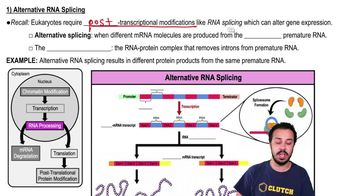
Alternative splicing is a post-transcriptional process in which a single gene can lead to multiple mRNA variants by including or excluding certain exons. This mechanism allows for the generation of diverse protein isoforms from a single gene, significantly increasing the complexity of gene expression and protein function in eukaryotic cells.
Recommended video:
Guided course
05:17
1) Alternative RNA Splicing

Exons and Introns

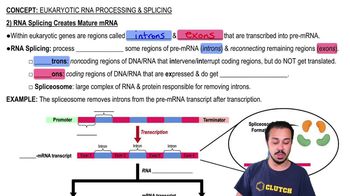
Exons are the coding regions of a gene that are retained in the final mRNA transcript, while introns are non-coding regions that are removed during mRNA processing. The arrangement and selection of exons during splicing determine the specific protein product synthesized, making the understanding of these elements crucial for grasping alternative splicing.
Recommended video:
Guided course
08:44
2) RNA Splicing Creates Mature mRNA

mRNA Processing

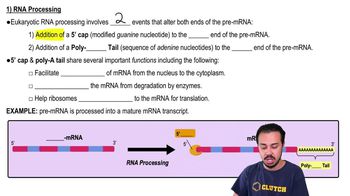
mRNA processing refers to the modifications that pre-mRNA undergoes before it becomes a mature mRNA molecule ready for translation. This includes capping, polyadenylation, and splicing, all of which are essential for the stability, transport, and translation of mRNA, and play a critical role in the regulation of gene expression.
Recommended video:
Guided course
04:19
1) RNA Processing