Pearson+ LogoPearson+ Logo
Ch. 19 - Control of Gene Expression in Eukaryotes
Freeman - Biological Science 7th Edition
Freeman7th EditionBiological ScienceISBN: 9783584863285Not the one you use?Change textbook
Chapter 19, Problem 5

Compare and contrast the items in each pair: (a) enhancers and the E. coli CAP binding site

Verified step by step guidance
1
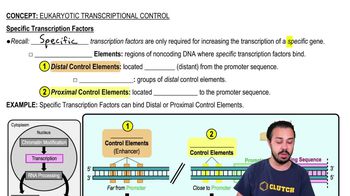
Identify the function of enhancers in eukaryotic gene regulation. Enhancers are DNA sequences that increase the rate of transcription of a gene when specific proteins (transcription factors) bind to them.
Understand the role of the CAP binding site in prokaryotes, specifically in E. coli. The catabolite activator protein (CAP) binding site is a DNA sequence that, when bound by CAP in the presence of cAMP, enhances the transcription of certain genes involved in energy metabolism.
Examine the location relevance of both enhancers and the CAP binding site. Enhancers can be located far from the gene they regulate and can be upstream, downstream, or within an intron of the target gene. In contrast, the CAP binding site is typically located near the promoter region of the genes it regulates.
Discuss the dependency on other molecules for functionality. Enhancers require the binding of multiple transcription factors to exert their effect, while the CAP binding site requires the binding of CAP which is activated by cAMP.
Compare the evolutionary aspect and specificity. Enhancers are a feature of eukaryotic organisms and have a wide variety of regulatory effects depending on the combination of transcription factors that bind. The CAP binding site is specific to prokaryotes and generally has a more uniform function in regulating genes involved in energy utilization.

Verified video answer for a similar problem:

This video solution was recommended by our tutors as helpful for the problem above.
Video duration:
41s
Was this helpful?

Key Concepts

Here are the essential concepts you must grasp in order to answer the question correctly.

Enhancers

Enhancers are regulatory DNA sequences that can significantly increase the transcription of associated genes. They function by providing binding sites for transcription factors, which can interact with the promoter region of a gene, facilitating the assembly of the transcription machinery. Enhancers can be located far from the genes they regulate and can work in a tissue-specific manner, influencing gene expression in a context-dependent way.
Recommended video:
Guided course
03:57
Specific Transcription Factors

E. coli CAP Binding Site

The CAP (catabolite activator protein) binding site in E. coli is a specific DNA sequence that allows the binding of the CAP protein, which is crucial for the regulation of gene expression in response to glucose levels. When glucose is low, CAP binds to this site, enhancing the transcription of operons involved in the metabolism of alternative sugars. This mechanism exemplifies how bacterial cells adapt their metabolic processes based on nutrient availability.
Recommended video:
Guided course
06:16
Ribosomal tRNA Binding Sites

Transcription Regulation

Transcription regulation refers to the mechanisms that control the rate and timing of gene expression. This process involves various elements, including promoters, enhancers, and transcription factors, which work together to ensure that genes are expressed at the right levels and at the appropriate times. Understanding transcription regulation is essential for comprehending how cells respond to environmental changes and maintain homeostasis.
Recommended video:
Guided course
01:56
Eukaryotic Post-Transcriptional Regulation