

Pearson+ LogoPearson+ Logo
Ch. 20 - The Molecular Revolution: Biotechnology, Genomics, and New Frontiers
Freeman - Biological Science 7th Edition
Freeman7th EditionBiological ScienceISBN: 9783584863285Not the one you use?Change textbook
Chapter 20, Problem 13

If the sequence of DNA in Question 12 were amplified using 25 PCR cycles, then the amount of this DNA would be predicted to increase by -fold.

Verified step by step guidance
1
Identify the initial amount of DNA present before amplification.
Understand that each cycle of PCR ideally doubles the amount of DNA.
Calculate the total amplification after 25 cycles by using the formula for exponential growth: Final amount = Initial amount imes 2^{number of cycles}.
Substitute 25 for the number of cycles in the formula to find the fold increase.
Interpret the result as the fold increase in the amount of DNA after 25 PCR cycles.

Verified video answer for a similar problem:

This video solution was recommended by our tutors as helpful for the problem above.
Video duration:
2m
Was this helpful?

Key Concepts

Here are the essential concepts you must grasp in order to answer the question correctly.

Polymerase Chain Reaction (PCR)

PCR is a molecular biology technique used to amplify specific DNA sequences. It involves repeated cycles of denaturation, annealing, and extension, allowing for exponential replication of the target DNA. Each cycle theoretically doubles the amount of DNA, making it a powerful tool for genetic analysis and research.
Recommended video:
Guided course
01:31
Introduction to Polymerase Chain Reaction

Exponential Growth in PCR

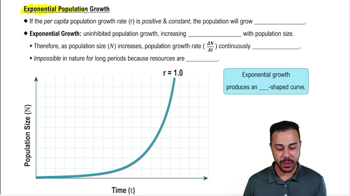
In PCR, the amount of DNA increases exponentially with each cycle. After n cycles, the amount of DNA can be calculated using the formula 2^n, where n is the number of cycles. Therefore, with 25 cycles, the DNA amount would increase by 2^25, illustrating the rapid amplification capability of this technique.
Recommended video:
Guided course
03:05
Exponential Population Growth

Cycle Threshold (Ct) and Efficiency

The cycle threshold (Ct) is the number of cycles required for the fluorescent signal to exceed the background level in quantitative PCR. The efficiency of PCR can affect the expected yield; ideally, each cycle should double the DNA, but inefficiencies can lead to lower than expected amplification. Understanding these factors is crucial for accurate predictions of DNA yield.
Recommended video:
Guided course
07:47
Making Sense of Ecosystem Production & Efficiency
Related Practice
Textbook Question
Potato blight causes potato plants to shrivel and rot. The disease is caused by the pathogen Phytophthora infestans, infamous for its role in Ireland's Great Potato Famine in the mid-1840s. The disease can devastate crops during wet weather, sometimes leading to total crop loss. Researchers aim to use recombinant DNA methods to transfer blight resistance genes from resistant varieties into susceptible varieties of potato.Transgenic plants usually contain genes of bacterial plasmid origin. In a recent study, researchers designed a strategy that avoided using any plasmid genes. They transformed cells from a susceptible potato variety with a potato blight resistance gene cloned from a resistant variety. Next, to determine which plants from this group were also free of plasmid DNA (cloning vector) sequences, they performed PCR using primers specific for the plasmid. The positive control lane shows PCR amplification of plasmid DNA only, and the negative control lane shows an attempted PCR amplification of no added DNA. Based on the gel analysis of PCR products shown below, which plants contain only the potato gene? Explain your answer.
893
views
Textbook Question

Potato blight causes potato plants to shrivel and rot. The disease is caused by the pathogen Phytophthora infestans, infamous for its role in Ireland's Great Potato Famine in the mid-1840s. The disease can devastate crops during wet weather, sometimes leading to total crop loss. Researchers aim to use recombinant DNA methods to transfer blight resistance genes from resistant varieties into susceptible varieties of potato. Transgenic plants usually contain genes of bacterial plasmid origin. In a recent study, researchers designed a strategy that avoided using any plasmid genes. They transformed cells from a susceptible potato variety with a potato blight resistance gene cloned from a resistant variety. Next, to determine which plants from this group were also free of plasmid DNA (cloning vector) sequences, they performed PCR using primers specific for the plasmid. The positive control lane shows PCR amplification of plasmid DNA only, and the negative control lane shows an attempted PCR amplification of no added DNA. Based on the gel analysis of PCR products shown below, which plants contain only the potato gene? Explain your answer.

627
views
Textbook Question

If the sequence of DNA in Question 12 were amplified using 25 PCR cycles, then the amount of this DNA would be predicted to increase by          -fold.

905
views
Textbook Question

Why was it important to include a positive control and a negative control in the PCR analysis?

1360
views
Textbook Question
Why was it important to include a positive control and a negative control in the PCR analysis?
1175
views
Textbook Question

How could the research group determine whether a homologous gene for blight resistance exists in the human genome?

658
views