
Pearson+ LogoPearson+ Logo
Ch. 21 - Genes, Development, and Evolution
Freeman - Biological Science 7th Edition
Freeman7th EditionBiological ScienceISBN: 9783584863285Not the one you use?Change textbook
Chapter 21, Problem 9

Imagine a situation in which a morphogen has its source at the posterior end of a Drosophila embryo. Every 100 µm from the posterior pole, the morphogen concentration decreases by half. If a cell required 1/16th the amount of morphogen found at the posterior pole to form part of a leg, how far from the posterior pole would the leg form?
a. 100μm
b. 160μm
c. 400μm
d. 1600 μm

Verified step by step guidance
1
Understand the concept of morphogen gradient: A morphogen is a substance that defines different cell fates in a concentration-dependent manner. In this problem, the morphogen concentration decreases by half every 100 µm from the posterior pole of the Drosophila embryo.
Identify the initial concentration at the posterior pole: Let's denote the initial concentration of the morphogen at the posterior pole as C₀.
Determine the concentration required for leg formation: The cell requires 1/16th of the initial concentration (C₀) to form part of a leg. Therefore, the required concentration is C₀/16.
Calculate the distance where the concentration is C₀/16: Since the concentration halves every 100 µm, we can express the concentration at a distance x as C₀/(2^(x/100)). Set this equal to C₀/16 and solve for x using the equation: C 0 2 x 100 = C 0 16
Solve the equation for x: Simplify the equation to find the value of x that satisfies the condition. This involves solving the equation 2 x 100 = 16 which can be solved by recognizing that 16 is 2 raised to the power of 4, thus x/100 = 4, leading to x = 400 µm.

Verified video answer for a similar problem:

This video solution was recommended by our tutors as helpful for the problem above.
Video duration:
2m
Was this helpful?

Key Concepts

Here are the essential concepts you must grasp in order to answer the question correctly.

Morphogen Gradient

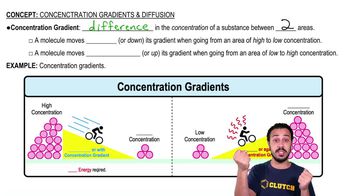
A morphogen gradient is a concentration gradient of a signaling molecule, known as a morphogen, which helps determine the fate of cells in a developing embryo. Cells interpret different concentrations of morphogens to activate specific developmental pathways. In this scenario, the morphogen concentration decreases by half every 100 µm from the posterior end, creating a gradient that influences cell differentiation.
Recommended video:
Guided course
04:51
Concentration Gradients and Diffusion

Exponential Decay

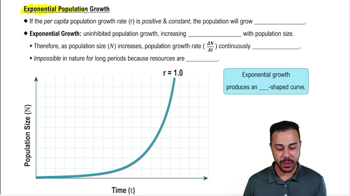
Exponential decay describes a process where a quantity decreases at a rate proportional to its current value. In the context of the morphogen gradient, the concentration halves every 100 µm, indicating an exponential decay pattern. Understanding this concept is crucial for calculating the distance at which the morphogen concentration reaches a specific fraction of its initial value.
Recommended video:
Guided course
03:05
Exponential Population Growth

Logarithmic Calculation

Logarithmic calculation is used to solve problems involving exponential changes, such as determining the distance at which a morphogen concentration reaches a specific fraction of its initial value. By applying the properties of logarithms, one can calculate the number of halving events needed to reach 1/16th of the initial concentration, which corresponds to the distance from the morphogen source.
Recommended video:
Guided course
02:10
Mark & Recapture: Calculations & Assumptions
Related Practice
Textbook Question

The following predictions ask you to consider how genetic regulatory cascades provide positional information. Select True or False for each statement.

T/F Mutation of a gene at one level of a regulatory cascade will affect the expression of genes at all levels of the cascade.

T/F Mutation of a gene that is expressed later in a regulatory cascade will affect a smaller region of the body than mutation of gene that is expressed early in the cascade.

T/F In the regulatory cascade used by Drosophila, a gene at one level of the cascade will be controlled only by genes at the level immediately above it.

T/F Genes that control the largest regions of the Drosophila embryo are not transcribed in the embryo.

667
views
Textbook Question

What is the connection between genetic regulatory cascades and the observation that differentiation is a step-by-step process?

629
views
Textbook Question

Which of the following provides the strongest evidence for the conservation of tool-kit genes?

a. Bicoid moved from one fly embryo into the posterior of another fly embryo causes the formation of two head regions.

b. Mutation of an unrelated gene in another species of fly has a similar effect to mutation of bicoid in Drosophila.

c. A mouse Hox gene can be used to take over the function of a mutated Drosophila Hox gene.

d. Sheep can be cloned by fusing a differentiated adult cell with an enucleated egg.

567
views
Textbook Question

Some stickleback fish develop protective spines, and other stickleback fish are spineless. Spine development is controlled by the expression of a gene known as Pitx1. The spineless phenotype is due to a mutation in Pitx1 that results in no expression of Pitx1 during development in regions where spines would otherwise form. When scientists compared the Pitx1 coding sequence in spined and spineless fish, they found this sequence was the same in both types of fish. Propose plausible hypotheses for the location of this mutation and for how it alters spine development.

660
views
Textbook Question

Type I diabetes is a form of diabetes that is due to the loss of insulin-producing cells of the pancreas. The potential of stem cells—in particular, induced pluripotent stem (iPS) cells—for therapy has gotten a lot of press.

What are iPS cells?

a. Cells taken from early human embryos

b. Cells taken from the pancreas of people without diabetes

c. Cells derived by de-differentiating specialized adult cells

d. Cells derived by differentiating pancreas precursor cells

660
views
Textbook Question

Type I diabetes is a form of diabetes that is due to the loss of insulin-producing cells of the pancreas. The potential of stem cells—in particular, induced pluripotent stem (iPS) cells—for therapy has gotten a lot of press.

If researchers were attempting to stimulate the differentiation of iPS cells, which of the following would they most likely add to the cell-culture medium (the liquid surrounding the cells)?

a. Activin A, an extracellular signal protein

b. Sox-2, a transcription factor active in early development

c. Grb-2, an intracellular signal transduction protein

d. Lactase, an enzyme that catalyzes the breakdown of lactose

555
views