
The geneticist James Crow wrote that successful scientific theories have the following characteristics: (1) They explain otherwise puzzling observations; (2) they provide connections between otherwise disparate observations; (3) they make predictions that can be tested; and (4) they are heuristic, meaning that they open up new avenues of theory and experimentation. Crow added two other elements of scientific theories that he considered important on a personal, emotional level: (5) They should be elegant, in the sense of being simple and powerful; and (6) they should have an element of surprise. How well does the theory of evolution by natural selection fulfill these six criteria?
Ch. 22 - Evolution by Natural Selection
Chapter 22, Problem 13
Most mice living on the mainland of Florida are brown, but the mice that live on the sand dunes of the barrier islands have white fur. The differences in color are heritable, determined by genes such as MC1R. It is intuitive that the light color of beach-dwelling mice is an adaptation for blending into their environment—and thus evading predators. Apply Darwin's four postulates to a population of mice living on sand dunes in coastal Florida.
Verified step by step guidance1
Identify the variation in the population: Observe the population of mice and note any differences in traits, such as fur color, size, or behavior. For example, some mice may have lighter fur while others have darker fur.
Determine heritability of traits: Establish whether the observed variations in traits, such as fur color, are heritable. This means that the trait can be passed from parents to offspring through genetic inheritance.
Assess differential survival and reproduction: Analyze how the different traits affect the mice's ability to survive and reproduce in their environment. For instance, mice with fur color that blends with the sand dunes may be less visible to predators, increasing their chances of survival and reproduction.
Evaluate the non-random survival and reproduction: Consider how the environment influences which traits are advantageous. In this case, the sand dunes may favor mice with lighter fur, leading to a higher survival rate for these individuals compared to those with darker fur.
Conclude with natural selection: Understand that over time, the advantageous traits (e.g., lighter fur) become more common in the population due to natural selection, as these traits increase the likelihood of survival and reproduction in the specific environment of the sand dunes.

Verified video answer for a similar problem:
This video solution was recommended by our tutors as helpful for the problem above.
Video duration:
3mWas this helpful?
Key Concepts
Here are the essential concepts you must grasp in order to answer the question correctly.
Darwin's Four Postulates
Darwin's four postulates are the foundation of the theory of natural selection. They include: variation among individuals in a population, inheritance of traits, differential survival and reproduction, and the influence of traits on survival and reproduction. These principles explain how populations evolve over time as advantageous traits become more common.
Recommended video:
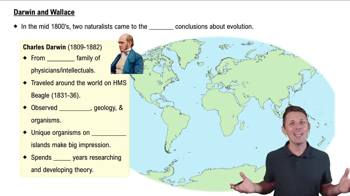
Darwin and Wallace
Variation in Populations
Variation refers to the differences in physical traits among individuals within a population. In the context of mice living on sand dunes, variation might include differences in fur color, size, or behavior. This diversity is crucial for natural selection, as it provides the raw material for evolution, allowing some individuals to be better suited to their environment.
Recommended video:
Sources of Genetic Variation
Adaptation to Environment
Adaptation is the process by which a species becomes better suited to its environment through natural selection. For mice in coastal Florida, adaptations might include fur color that blends with the sandy environment, enhancing their survival by reducing predation. Over time, these advantageous traits become more prevalent in the population, demonstrating the power of natural selection.
Recommended video:
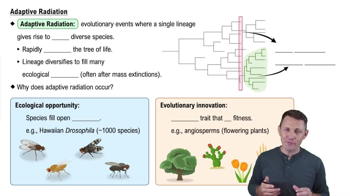
Adaptive Radiation
Related Practice
Textbook Question
678
views
Textbook Question
Most mice living on the mainland of Florida are brown, but the mice that live on the sand dunes of the barrier islands have white fur. The differences in color are heritable, determined by genes such as MC1R. It is intuitive that the light color of beach-dwelling mice is an adaptation for blending into their environment—and thus evading predators.Compare how evolution by inheritance of acquired characters and the theory of evolution by natural selection would explain the observation of white mice living primarily on light soil and brown mice living primarily on dark soil.
1323
views
Textbook Question
What is an evolutionary adaptation?
a. A trait that improves the fitness of its bearer, compared with individuals without the trait
b. A trait that changes in response to environmental influences within the individual's lifetime
c. The ability of an individual to adjust to its environment
d. A trait that an individual wants so that it can survive
1179
views
Textbook Question
A team led by evolutionary biologist Hopi Hoekstra set out to test the hypothesis that predators are an agent of natural selection on mouse color. They made 250 plasticine models of mice that were alike in every way except that half were painted white and half were painted brown. Suggest one advantage and one disadvantage of using model mice instead of real mice in this experiment.
1100
views
Textbook Question
The researchers placed white and brown mouse models both in abandoned fields on the mainland (dark soil) and on sand dunes on the islands (light soil) and then measured the percentage of models that were attacked by predators. What is the take-home message of the data? Do the data support or reject the hypothesis that mouse color is adaptive?
1142
views
