Pearson+ LogoPearson+ Logo
Ch. 32 - Deuterostome Animals
Freeman - Biological Science 7th Edition
Freeman7th EditionBiological ScienceISBN: 9783584863285Not the one you use?Change textbook
Chapter 32, Problem 6

Compare amniotic eggs to placentas.

Verified step by step guidance
1
Identify the primary function: Both amniotic eggs and placentas serve the purpose of nurturing and protecting the developing embryo. However, they are found in different groups of animals and have distinct structures and functions.
Describe amniotic eggs: Amniotic eggs are found in reptiles, birds, and some mammals like monotremes. They have several layers including a hard or leathery shell that provides protection, and membranes that store waste and facilitate gas exchange.
Explain placentas: Placentas are found in most mammals. They are organs formed in the uterus during pregnancy that provide oxygen and nutrients to the growing fetus through the umbilical cord, while also removing waste products.
Compare development environments: Amniotic eggs develop externally, where the embryo grows inside the egg outside the mother's body. In contrast, development in species with placentas occurs internally, with the fetus developing inside the uterus connected to the mother.
Discuss evolutionary significance: The development of amniotic eggs allowed for reproduction away from water bodies, facilitating the colonization of diverse terrestrial environments. The evolution of the placenta allowed for more direct nurturing of the young, leading to longer gestation periods and more developed offspring at birth.

Verified video answer for a similar problem:

This video solution was recommended by our tutors as helpful for the problem above.
Video duration:
56s
Was this helpful?

Key Concepts

Here are the essential concepts you must grasp in order to answer the question correctly.

Amniotic Eggs

Amniotic eggs are a type of egg that contains a protective amniotic membrane, allowing for the development of embryos in a terrestrial environment. This adaptation is crucial for reptiles, birds, and some mammals, as it prevents desiccation and provides a stable environment for growth. The egg contains various membranes and fluids that support the embryo, facilitating gas exchange and nutrient absorption.
Recommended video:

Placentas

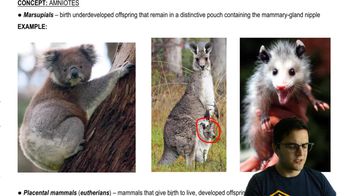
Placentas are specialized organs that develop in the uterus of eutherian (placental) mammals, facilitating nutrient and gas exchange between the mother and the developing fetus. The placenta allows for a more direct and efficient transfer of oxygen and nutrients, while also removing waste products. This structure supports longer gestation periods and more complex development compared to amniotic eggs.
Recommended video:
Guided course
02:12
Marsupials and Placental Mammals

Reproductive Strategies

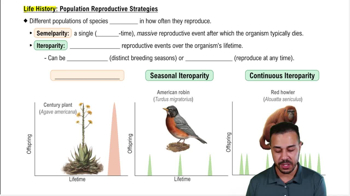
Reproductive strategies refer to the various methods organisms use to reproduce and ensure the survival of their offspring. Amniotic eggs represent an oviparous strategy, where eggs are laid and develop outside the mother's body, while placentas exemplify viviparous reproduction, where the young develop inside the mother. These strategies reflect adaptations to different environmental pressures and life history traits.
Recommended video:
Guided course
02:51
Life History: Population Reproductive Strategies
Related Practice
Textbook Question

What two major lineages make up the living Amniota?

950
views
Textbook Question

Most species of hominins are known only from Africa. Which species have been found in other parts of the world as well?

a. Early Homo—H. habilis and H. ergaster

b. H. erectus, H. neanderthalensis, and H. floresiensis

c. Gracile australopithecines

d. Robust australopithecines

1396
views
Textbook Question

Which statement is true about endothermy in mammals and birds?

a. They both inherited this trait from a common ancestor.

b. Birds are more closely related to mammals than to reptiles.

c. Endothermy arose independently in these two lineages.

d. Birds are reptiles and all reptiles are ectothermic.

683
views
Textbook Question
There is some evidence that pharyngeal slits occur in certain species of echinoderms that appear early in the fossil record. If confirmed, what do these data suggest?a. Echinoderms are chordates.b. Pharyngeal slits were present in the earliest echinoderms and lost later.c. Some lineages of echinoderms are more closely related to chordates than others.d. Pharyngeal slits should not be used as a trait in phylogenetic analysis.
1055
views
Textbook Question

There is some evidence that pharyngeal slits occur in certain species of echinoderms that appear early in the fossil record. If confirmed, what do these data suggest?

a. Echinoderms are chordates.

b. Pharyngeal slits were present in the earliest echinoderms and lost later.

c. Some lineages of echinoderms are more closely related to chordates than others.

d. Pharyngeal slits should not be used as a trait in phylogenetic analysis.

710
views
Textbook Question

Draw a phylogeny of major populations of modern humans that would reject the out-of-Africa hypothesis.

1060
views