Pearson+ LogoPearson+ Logo
Ch. 32 - Deuterostome Animals
Freeman - Biological Science 7th Edition
Freeman7th EditionBiological ScienceISBN: 9783584863285Not the one you use?Change textbook
Chapter 32, Problem 7

There is some evidence that pharyngeal slits occur in certain species of echinoderms that appear early in the fossil record. If confirmed, what do these data suggest?
a. Echinoderms are chordates.
b. Pharyngeal slits were present in the earliest echinoderms and lost later.
c. Some lineages of echinoderms are more closely related to chordates than others.
d. Pharyngeal slits should not be used as a trait in phylogenetic analysis.

Verified step by step guidance
1
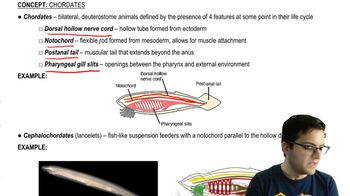
Understand the significance of pharyngeal slits: Pharyngeal slits are openings in the pharynx that are characteristic of chordates, a group that includes vertebrates, tunicates, and cephalochordates. These structures are often associated with filter feeding or respiration in early chordates.
Review the evolutionary relationship between echinoderms and chordates: Both echinoderms and chordates belong to the deuterostomes, a major clade of animals. This shared ancestry suggests that certain traits, like pharyngeal slits, could have been present in their common ancestor.
Consider the implications of finding pharyngeal slits in early echinoderms: If pharyngeal slits are confirmed in early echinoderms, it suggests that this trait may have been present in the common ancestor of echinoderms and chordates, but was later lost in modern echinoderms.
Evaluate the options provided in the question: Analyze each answer choice in light of the evolutionary context. For example, option (a) suggests echinoderms are chordates, which is incorrect because echinoderms are a separate group within deuterostomes. Option (b) aligns with the idea that pharyngeal slits were ancestral and lost later. Option (c) implies varying degrees of relatedness among echinoderm lineages, which is not supported by current phylogenetic evidence. Option (d) dismisses the use of pharyngeal slits in phylogenetic analysis, which is not scientifically justified.
Conclude based on evolutionary reasoning: The most plausible interpretation is that pharyngeal slits were present in the earliest echinoderms and lost later, as this aligns with the idea of shared ancestral traits within deuterostomes. This supports option (b).

Verified video answer for a similar problem:

This video solution was recommended by our tutors as helpful for the problem above.
Video duration:
1m
Was this helpful?

Key Concepts

Here are the essential concepts you must grasp in order to answer the question correctly.

Pharyngeal Slits

Pharyngeal slits are openings that occur in the pharynx, which is part of the digestive tract, and are a characteristic feature of chordates during their embryonic development. In some species, these structures can persist into adulthood, while in others, they may only be present during early development. Their presence is significant in evolutionary biology as they provide insights into the relationships between different animal groups.
Recommended video:

Echinoderm and Chordate Relationship

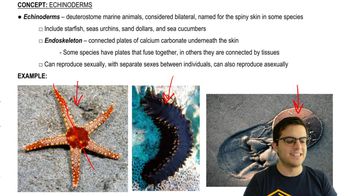
Echinoderms, such as starfish and sea urchins, and chordates, which include vertebrates, share a common ancestor, making them part of the larger clade Deuterostomia. Understanding the evolutionary relationship between these two groups is crucial for interpreting fossil evidence and determining the evolutionary history of traits like pharyngeal slits. This relationship suggests that certain features may have been present in early deuterostomes before diverging into distinct lineages.
Recommended video:

Phylogenetic Analysis

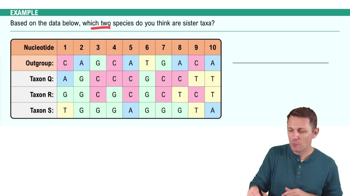
Phylogenetic analysis is a method used to infer the evolutionary relationships among various biological species based on similarities and differences in their physical or genetic characteristics. Traits such as pharyngeal slits can be used as markers in constructing phylogenetic trees, which help scientists understand how species are related and how they have evolved over time. The interpretation of these traits is essential for accurate evolutionary conclusions.
Recommended video:
04:13
Building Phylogenetic Trees Example 2
Related Practice
Textbook Question

Which statement is true about endothermy in mammals and birds?

a. They both inherited this trait from a common ancestor.

b. Birds are more closely related to mammals than to reptiles.

c. Endothermy arose independently in these two lineages.

d. Birds are reptiles and all reptiles are ectothermic.

683
views
Textbook Question

Compare amniotic eggs to placentas.

1053
views
Textbook Question
There is some evidence that pharyngeal slits occur in certain species of echinoderms that appear early in the fossil record. If confirmed, what do these data suggest?a. Echinoderms are chordates.b. Pharyngeal slits were present in the earliest echinoderms and lost later.c. Some lineages of echinoderms are more closely related to chordates than others.d. Pharyngeal slits should not be used as a trait in phylogenetic analysis.
1055
views
Textbook Question

Draw a phylogeny of major populations of modern humans that would reject the out-of-Africa hypothesis.

1060
views
Textbook Question

Consider the evolution of protostomes and deuterostomes (this chapter):

Compare adaptations in protostomes and deuterostomes for living on land.

Recall that changes in the expression patterns of tool-kit genes in arthropods such as insects enabled a dramatic diversification of their segmented appendages and bodies.

Design an experiment to test whether this concept applies to vertebrates.

1198
views
Textbook Question

Genetic diversity in living human populations is highest in Africa and decreases as a function of distance traveled by the human migration that left Africa many millennia ago. Draw a graph to show this trend. (Hint: What is the independent variable? What is the dependent variable? What kind of graph is appropriate for this kind of data? Add a label where you would expect to find a data point for the Yanomamö tribe of the Amazon rain forest in South America. Why is it important to use indigenous people for this study?

983
views