Pearson+ LogoPearson+ Logo
Ch. 32 - Deuterostome Animals
Freeman - Biological Science 7th Edition
Freeman7th EditionBiological ScienceISBN: 9783584863285Not the one you use?Change textbook
Chapter 32, Problem 9

Consider the evolution of protostomes and deuterostomes (this chapter):
Compare adaptations in protostomes and deuterostomes for living on land.
Recall that changes in the expression patterns of tool-kit genes in arthropods such as insects enabled a dramatic diversification of their segmented appendages and bodies.
Design an experiment to test whether this concept applies to vertebrates.

Verified step by step guidance
1
Step 1: Compare adaptations in protostomes and deuterostomes for living on land. Protostomes, such as arthropods and mollusks, have developed exoskeletons and specialized respiratory structures like tracheae or book lungs to minimize water loss and facilitate gas exchange. Deuterostomes, including vertebrates, have evolved internal skeletons and lungs, which allow for efficient support and respiration in terrestrial environments.
Step 2: Understand the role of tool-kit genes in diversification. Tool-kit genes are a set of genes that control the development of body plans and structures. In arthropods, changes in the expression patterns of these genes have led to the diversification of segmented appendages and body structures.
Step 3: Design an experiment to test the concept in vertebrates. Identify a set of tool-kit genes known to be involved in vertebrate development, such as Hox genes. Use a model organism, like zebrafish or mice, to manipulate the expression of these genes during development.
Step 4: Implement the experiment. Use techniques such as CRISPR-Cas9 to edit the expression patterns of the selected tool-kit genes in the model organism. Observe and document any changes in the development of body structures or appendages.
Step 5: Analyze the results. Compare the altered expression patterns and resulting phenotypes with the normal development in the control group. Determine if changes in tool-kit gene expression lead to diversification in vertebrate body structures, similar to the process observed in arthropods.

Verified video answer for a similar problem:

This video solution was recommended by our tutors as helpful for the problem above.
Video duration:
1m
Was this helpful?

Key Concepts

Here are the essential concepts you must grasp in order to answer the question correctly.

Protostomes and Deuterostomes

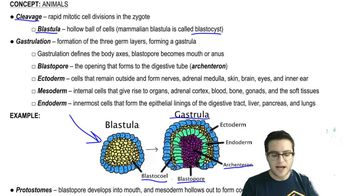
Protostomes and deuterostomes are two major groups of animals distinguished by their embryonic development. In protostomes, the mouth develops from the first opening (blastopore), while in deuterostomes, the anus develops first. This distinction is crucial for understanding their evolutionary adaptations, particularly in how they have adapted to terrestrial environments.
Recommended video:
Guided course
06:59
Overview of Animals - 2

Adaptations for Terrestrial Life

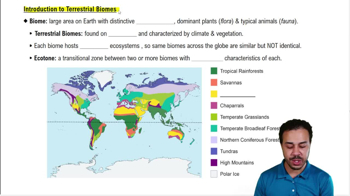
Adaptations for living on land involve changes in structure and function to overcome challenges such as desiccation, respiration, and locomotion. Protostomes, like insects, have developed exoskeletons and tracheal systems, while deuterostomes, such as mammals, have evolved lungs and supportive skeletal structures. These adaptations highlight the evolutionary innovations necessary for terrestrial survival.
Recommended video:
Guided course
01:55
Introduction to Terrestrial Biomes

Tool-kit Genes and Evolutionary Diversification

Tool-kit genes are a set of genes that control the development of an organism's body plan and structures. Changes in their expression can lead to significant morphological diversification, as seen in arthropods. Investigating whether similar genetic mechanisms apply to vertebrates involves examining how alterations in these genes might influence vertebrate morphology and adaptation, providing insights into evolutionary processes.
Recommended video:
04:22
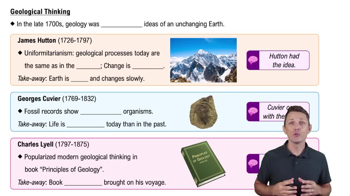
Geological Thinking
Related Practice
Textbook Question
There is some evidence that pharyngeal slits occur in certain species of echinoderms that appear early in the fossil record. If confirmed, what do these data suggest?a. Echinoderms are chordates.b. Pharyngeal slits were present in the earliest echinoderms and lost later.c. Some lineages of echinoderms are more closely related to chordates than others.d. Pharyngeal slits should not be used as a trait in phylogenetic analysis.
1055
views
Textbook Question

There is some evidence that pharyngeal slits occur in certain species of echinoderms that appear early in the fossil record. If confirmed, what do these data suggest?

a. Echinoderms are chordates.

b. Pharyngeal slits were present in the earliest echinoderms and lost later.

c. Some lineages of echinoderms are more closely related to chordates than others.

d. Pharyngeal slits should not be used as a trait in phylogenetic analysis.

710
views
Textbook Question

Draw a phylogeny of major populations of modern humans that would reject the out-of-Africa hypothesis.

1060
views
Textbook Question

Genetic diversity in living human populations is highest in Africa and decreases as a function of distance traveled by the human migration that left Africa many millennia ago. Draw a graph to show this trend. (Hint: What is the independent variable? What is the dependent variable? What kind of graph is appropriate for this kind of data? Add a label where you would expect to find a data point for the Yanomamö tribe of the Amazon rain forest in South America. Why is it important to use indigenous people for this study?

983
views
Textbook Question

Humans possess which of the following traits? Select True or False for each trait. T/F triploblasty T/F parthenogenesis T/F viviparity T/F metamorphosis

715
views
Textbook Question

The size and shape of the vertebrate skull can reveal a great deal about an animal's lifestyle and evolutionary relationships. Consider your own skull. If you put your finger in your ear and move your jaw up and down, you can feel the space near the hinge of your jaw. Nestled in this space are the tiny bones that make your hearing possible: the malleus, incus, and stapes. All mammals have these three ear bones, but reptiles such as this T. rex don't.

Where did ear bones come from?

Analyze the morphological data shown here and write a hypothesis to explain the origin of mammalian ear bones. (The cynodont shown is one of many extinct synapsid amniotes that lived early in the lineage that gave rise to mammals.)

504
views