
Pearson+ LogoPearson+ Logo
Ch. 43 - Animal Nervous Systems
Freeman - Biological Science 7th Edition
Freeman7th EditionBiological ScienceISBN: 9783584863285Not the one you use?Change textbook
Chapter 43, Problem 16f

Certain species of frogs in the genus Phyllobates have a powerful defensive adaptation—their skin can secrete a milky fluid that contains an extremely toxic compound called batrachotoxin (BTX). These frogs, which are found in Colombia, are known as poison dart frogs because some indigenous Colombian hunters coat the tips of their blowgun darts with the frogs' skin secretions. An animal hit by one of these darts dies quickly.
What is the mechanism of action of BTX?
Although BTX is a powerful antipredator poison, one snake species in Colombia eats poison dart frogs. Suggest a hypothesis that might explain how the snake is resistant to the toxin.

Verified step by step guidance
1
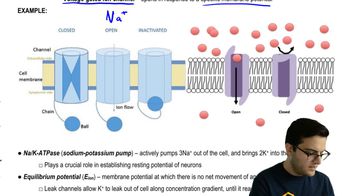
Understand the mechanism of action of batrachotoxin (BTX): BTX is a potent toxin that affects the nervous system by binding to and permanently opening voltage-gated sodium channels in nerve cells. This causes a continuous influx of sodium ions, leading to persistent depolarization of the nerve cell membrane, which disrupts normal nerve signaling and can result in paralysis and death.
Consider the ecological context: Poison dart frogs use BTX as a defense mechanism against predators. However, some predators, like certain snake species, have evolved resistance to this toxin, allowing them to prey on these frogs.
Formulate a hypothesis for the snake's resistance: One possible hypothesis is that the snake has evolved a mutation in the sodium channels that prevents BTX from binding effectively. This mutation could alter the structure of the sodium channels, reducing the toxin's ability to open them permanently.
Explore alternative hypotheses: Another hypothesis could be that the snake has developed a detoxification mechanism, such as enzymes that degrade BTX before it can affect the nervous system. Alternatively, the snake might have a physiological adaptation that allows it to tolerate higher levels of sodium influx without detrimental effects.
Consider evolutionary implications: The snake's resistance to BTX likely provides a selective advantage, allowing it to exploit a food source that is unavailable to other predators. This resistance could have evolved through natural selection, where individuals with mutations or adaptations that confer resistance to BTX are more likely to survive and reproduce.

Verified video answer for a similar problem:

This video solution was recommended by our tutors as helpful for the problem above.
Video duration:
1m
Was this helpful?

Key Concepts

Here are the essential concepts you must grasp in order to answer the question correctly.

Batrachotoxin (BTX)

Batrachotoxin (BTX) is a potent neurotoxin found in certain species of poison dart frogs. It works by binding to voltage-gated sodium channels in nerve cells, forcing them to remain open. This disrupts normal nerve function, leading to paralysis and potentially fatal outcomes. Understanding BTX's mechanism is crucial for comprehending its role as a defensive adaptation.

Voltage-gated Sodium Channels

Voltage-gated sodium channels are essential for the generation and propagation of action potentials in neurons. They open in response to changes in membrane potential, allowing sodium ions to flow into the cell, which is critical for nerve signal transmission. BTX affects these channels by keeping them open, disrupting normal nerve function and leading to paralysis.
Recommended video:
Guided course
08:38
Ion Channels and Pumps

Toxin Resistance in Predators

Toxin resistance in predators, such as the snake species that preys on poison dart frogs, may involve genetic mutations or adaptations that alter the structure or function of sodium channels, preventing BTX binding. Alternatively, the snake might possess detoxifying enzymes or transport mechanisms that neutralize or expel the toxin, allowing it to safely consume the frogs.
Recommended video:
Guided course
03:40
Introduction to Pathogenic Toxins
Related Practice
Textbook Question

Certain species of frogs in the genus Phyllobates have a powerful defensive adaptation—their skin can secrete a milky fluid that contains an extremely toxic compound called batrachotoxin (BTX). These frogs, which are found in Colombia, are known as poison dart frogs because some indigenous Colombian hunters coat the tips of their blowgun darts with the frogs' skin secretions. An animal hit by one of these darts dies quickly.

What is the mechanism of action of BTX? As the graph in Question 11 shows, BTX depolarizes the membrane and prevents repolarization.

What effect would this have on electrical signaling by the nervous system?

876
views
Textbook Question

Certain species of frogs in the genus Phyllobates have a powerful defensive adaptation—their skin can secrete a milky fluid that contains an extremely toxic compound called batrachotoxin (BTX). These frogs, which are found in Colombia, are known as poison dart frogs because some indigenous Colombian hunters coat the tips of their blowgun darts with the frogs' skin secretions. An animal hit by one of these darts dies quickly.

What is the mechanism of action of BTX?

Like neurons, cells in skeletal and cardiac muscle also produce action potentials. Create a concept map showing how BTX could kill a mammal through its effects on nervous and muscle tissues.

696
views
Textbook Question

Certain species of frogs in the genus Phyllobates have a powerful defensive adaptation—their skin can secrete a milky fluid that contains an extremely toxic compound called batrachotoxin (BTX). These frogs, which are found in Colombia, are known as poison dart frogs because some indigenous Colombian hunters coat the tips of their blowgun darts with the frogs' skin secretions. An animal hit by one of these darts dies quickly.

What is the mechanism of action of BTX?

Predict the effects of each of the following on the membrane potential of a neuron simultaneously poisoned with BTX:

(a) Removing extracellular sodium ions;

(b) Increasing the intracellular potassium ion concentration;

(c) Adding tetrodotoxin from puffer fish.

583
views