

Pearson+ LogoPearson+ Logo
Ch. 43 - Animal Nervous Systems
Freeman - Biological Science 7th Edition
Freeman7th EditionBiological ScienceISBN: 9783584863285Not the one you use?Change textbook
Chapter 43, Problem 1

Which ion most readily leaks across a neuron's membrane, helping to establish the resting potential?

Verified step by step guidance
1
Identify the key ions involved in neuronal function: Sodium (Na+), Potassium (K+), Chloride (Cl-), and Calcium (Ca2+).
Understand the role of the neuron's membrane in ion movement: The neuron's membrane is selectively permeable, allowing some ions to pass more easily than others.
Recognize the importance of potassium (K+) in establishing the resting potential: Potassium ions have channels that are typically more permeable than those for other ions, allowing K+ to leak out of the neuron more readily.
Consider the electrochemical gradient: Potassium ions move out of the neuron, down their concentration gradient, which contributes to the negative charge inside the neuron relative to the outside.
Conclude that Potassium (K+) is the ion that most readily leaks across a neuron's membrane, helping to establish the resting potential.

Verified video answer for a similar problem:

This video solution was recommended by our tutors as helpful for the problem above.
Video duration:
58s
Was this helpful?

Key Concepts

Here are the essential concepts you must grasp in order to answer the question correctly.

Resting Potential

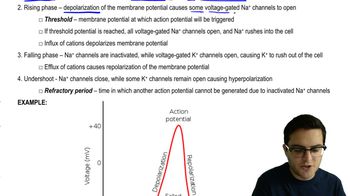
Resting potential refers to the electrical charge difference across a neuron's membrane when it is not actively transmitting a signal. This potential is typically around -70 mV and is maintained by the distribution of ions, particularly sodium (Na+) and potassium (K+), across the membrane. The resting potential is crucial for the generation of action potentials, which are necessary for neuronal communication.
Recommended video:
Guided course
09:55
Action Potential

Ion Channels

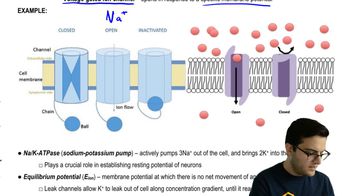
Ion channels are protein structures embedded in the cell membrane that allow specific ions to pass in and out of the neuron. These channels can be voltage-gated or leak channels, with leak channels being responsible for the passive movement of ions, such as potassium (K+), which predominantly leaks out of the neuron, contributing to the resting potential. The selective permeability of these channels is vital for maintaining the resting state of the neuron.
Recommended video:
Guided course
08:38
Ion Channels and Pumps

Potassium Ions (K+)

Potassium ions (K+) are the primary ions that leak across the neuron's membrane, significantly influencing the resting potential. Due to a higher concentration of K+ inside the neuron compared to the outside, K+ ions tend to diffuse out through leak channels. This efflux of K+ contributes to the negative charge inside the neuron, establishing the resting potential and preparing the neuron for potential action potentials.
Recommended video:
Guided course
04:08
r/K Selection