Back

DNA Sequencing quiz

Control buttons has been changed to "navigation" mode.
1/15
  • What is the main goal of DNA sequencing?

    The main goal is to identify the order of nucleotides (A, T, C, G) in a DNA molecule.
  • What is another name for the dideoxy method of DNA sequencing?

    The dideoxy method is also known as Sanger sequencing.
  • What special type of nucleotide is used in Sanger sequencing?

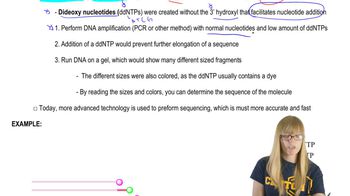
    Dideoxynucleotides (ddNTPs) are used in Sanger sequencing.
  • Why do ddNTPs stop DNA replication when incorporated?

    ddNTPs lack a 3' hydroxyl group, which is necessary for adding more nucleotides, so replication stops.
  • How are ddNTPs different from normal nucleotides?

    ddNTPs do not have a 3' hydroxyl group, while normal nucleotides do.
  • What is the role of PCR in Sanger sequencing?

    PCR amplifies the DNA and allows incorporation of both normal nucleotides and ddNTPs.
  • Why are ddNTPs added at low concentrations during sequencing?

    They are added at low concentrations so that replication only occasionally stops, creating fragments of different lengths.
  • What happens when a ddNTP is incorporated during DNA synthesis?

    DNA synthesis stops at the point where the ddNTP is added.
  • How are the DNA fragments generated in Sanger sequencing analyzed?

    They are separated by size using a gel, and the color of the dye on each fragment indicates the terminal nucleotide.
  • What does the color of a fragment in Sanger sequencing indicate?

    The color indicates which nucleotide (A, T, C, or G) is at the end of the fragment.
  • How does Sanger sequencing allow you to determine the DNA sequence?

    By analyzing the sizes and colors of the fragments, you can deduce the order of nucleotides.
  • What are the typical dye colors used for each nucleotide in Sanger sequencing?

    T is pink, A is green, G is blue, and C is red.
  • Why do you get DNA fragments of different lengths in Sanger sequencing?

    Because ddNTPs randomly stop replication at different points, resulting in fragments ending at various nucleotides.
  • Is Sanger sequencing still commonly used today?

    It is still used but has largely been replaced by more advanced sequencing technologies.
  • Why is it important to understand the history of DNA sequencing methods like Sanger sequencing?

    Understanding these methods shows how scientists first determined DNA sequences and laid the groundwork for modern techniques.