Back

Golgi Processing and Transport definitions

Control buttons has been changed to "navigation" mode.
1/16
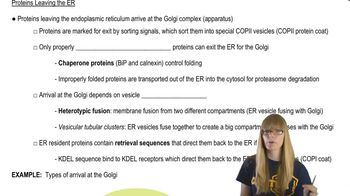
  • COP II Vesicle

    Membrane-bound carrier coated with a specific protein, responsible for transporting properly folded proteins from the ER to the Golgi.
  • Sorting Signal

    Short amino acid sequence on a protein that directs its transport to specific cellular compartments, ensuring correct localization.
  • Proteasome

    Large protein complex that degrades misfolded or damaged proteins, maintaining cellular protein quality control.
  • KDEL Sequence

    Retrieval tag on ER-resident proteins that ensures their return from the Golgi if they are mistakenly transported away.
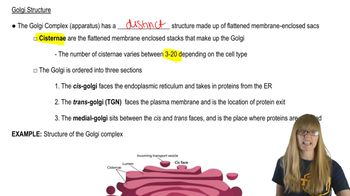
  • Cisternae

    Flattened, membrane-enclosed sacs that stack to form the structural units of the Golgi apparatus.
  • Cis Golgi

    Region of the Golgi facing the ER, serving as the entry point for newly arrived proteins from the ER.
  • Trans Golgi

    Region of the Golgi oriented toward the plasma membrane, functioning as the exit site for processed proteins.
  • Medial Golgi

    Central section of the Golgi apparatus, situated between the cis and trans regions, where intermediate protein modifications occur.
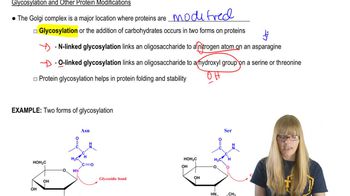
  • Glycosylation

    Addition of carbohydrate groups to proteins, crucial for their folding, stability, and function, primarily occurring in the Golgi.
  • N-linked Glycosylation

    Attachment of sugars to the nitrogen atom of asparagine residues, with final modifications completed in the Golgi.
  • O-linked Glycosylation

    Addition of sugars to the hydroxyl group of serine or threonine residues, predominantly taking place in the Golgi.
  • Terminal Glycosylation

    Final carbohydrate modification step in the Golgi, essential for completing protein maturation before export.
  • Vesicular Transport Model

    Concept where proteins move through stationary Golgi cisternae via transport vesicles shuttling cargo between stacks.
  • Cisternal Maturation Model

    Theory proposing that Golgi cisternae themselves progress forward, carrying proteins as they mature and change identity.
  • Anterograde Transport

    Directional movement of proteins from the ER through the Golgi toward the plasma membrane for secretion or delivery.
  • Retrograde Transport

    Return pathway for proteins from the plasma membrane or Golgi back to earlier compartments, such as the ER.