Back

Complex Numbers quiz

Control buttons has been changed to "navigation" mode.
1/15
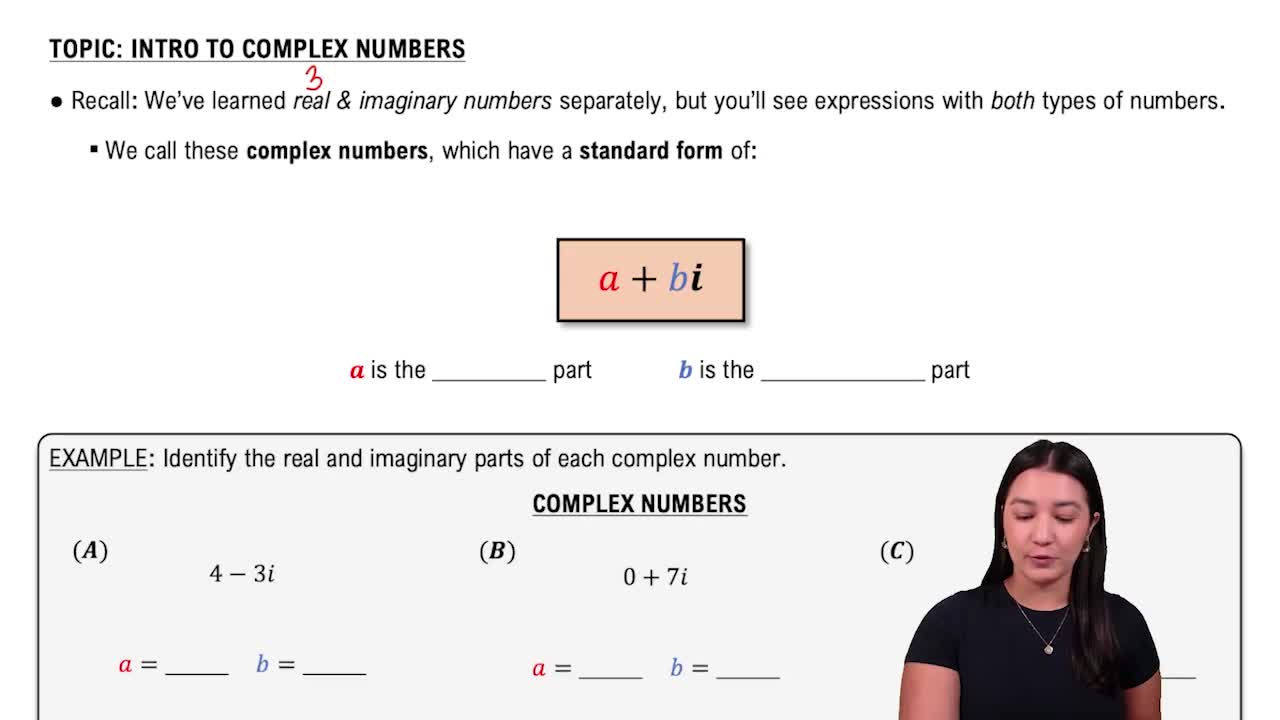
  • What is the standard form of a complex number?

    The standard form is a+bi, where 'a' is the real part and 'b' is the imaginary part multiplied by 'i'.
  • In the complex number 4-3i, what are the real and imaginary parts?

    The real part is 4, and the imaginary part is -3.
  • How do you identify the imaginary part in a complex number?

    The imaginary part is the coefficient multiplying the imaginary unit 'i'.
  • What is the real part of 0+7i?

    The real part is 0.
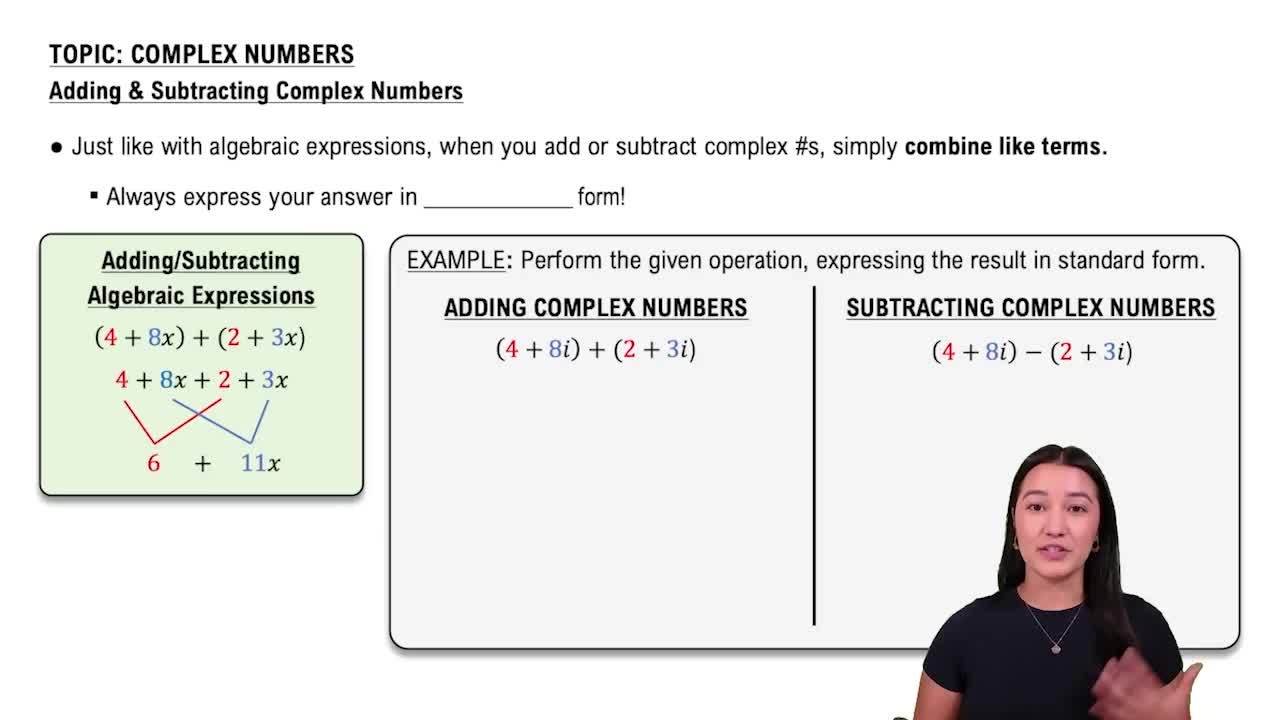
  • How do you add complex numbers like 4+8i and 2+3i?

    Combine the real parts and the imaginary parts separately to get 6+11i.
  • What must you always do after adding or subtracting complex numbers?

    Express the answer in standard form, a+bi.
  • How do you subtract complex numbers such as 4+8i minus 2+3i?

    Distribute the negative sign, combine like terms, and write the answer as 2+5i.
  • What is the value of i squared (i^2)?

    i^2 equals -1.
  • When multiplying complex numbers, what should you do with i^2 terms?

    Replace i^2 with -1 to simplify the expression.
  • What is the result of multiplying 3i by 7-2i?

    The result is 6+21i.
  • What is the complex conjugate of a+bi?

    The complex conjugate is a-bi.
  • How do you find the complex conjugate of 1+2i?

    Reverse the sign of the imaginary part to get 1-2i.
  • What happens when you multiply a complex number by its conjugate?

    You get a real number equal to a^2+b^2.
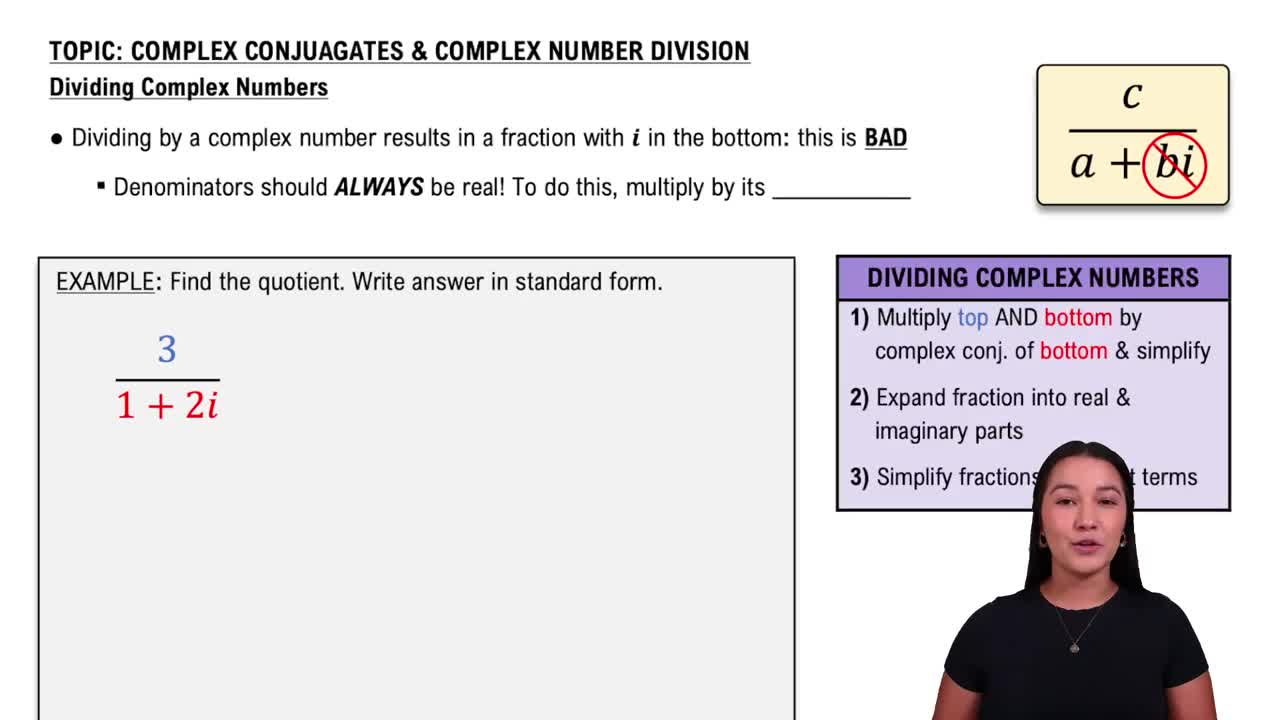
  • Why do you multiply the numerator and denominator by the conjugate when dividing complex numbers?

    To eliminate the imaginary unit 'i' from the denominator and simplify the expression.
  • What is the result of dividing 3 by 1+2i?

    The result is 3/5 - (6/5)i.