Back

The Number e quiz

Control buttons has been changed to "navigation" mode.
1/15
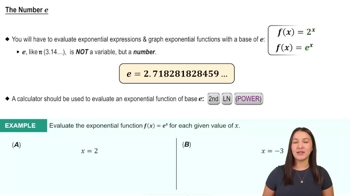
  • What is the approximate value of the mathematical constant e?

    The constant e is approximately equal to 2.71828.
  • How is the number e similar to pi in mathematics?

    Both e and pi are irrational numbers with long decimal representations and are treated as constants in mathematical expressions.
  • What is the function f(x) = e^x called?

    It is called an exponential function with base e.
  • How do you evaluate e^x on a calculator?

    You use the 'second ln' function, then enter the exponent value.
  • What is the value of e^2 rounded to the nearest hundredth?

    e^2 is approximately 7.39.
  • How do you evaluate e^-3 using exponent rules?

    e^-3 is equal to 1 divided by e^3.
  • What is the value of e^-3 rounded to the nearest hundredth?

    e^-3 is approximately 0.05.
  • How does the graph of f(x) = e^x compare to graphs of f(x) = 2^x and f(x) = 3^x?

    The graph of f(x) = e^x lies between the graphs of f(x) = 2^x and f(x) = 3^x.
  • Can exponential functions with base e be graphed using the same techniques as other bases?

    Yes, they can be graphed using the same methods and transformations as other exponential functions.
  • Where does the number e originate from in mathematics?

    e originates from the concept of continuously compounding interest.
  • What mathematical expression approaches e as n approaches infinity?

    The expression (1 + 1/n)^n approaches e as n approaches infinity.
  • In what real-world scenarios does the constant e appear?

    e appears in formulas for population growth, radioactive decay, and other exponential growth or decay situations.
  • Is e a variable or a constant in exponential functions?

    e is a constant, not a variable.
  • How should you treat e when working with exponential functions?

    You should treat e just like any other numerical base in exponential functions.
  • Why is the base e important in mathematics and science?

    The base e is important because it describes continuous growth and decay processes and appears in many natural and financial contexts.