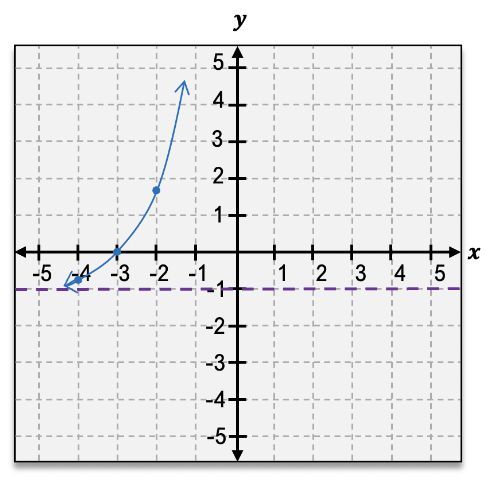
When dealing with exponential functions, you may encounter the base e, which is approximately equal to 2.71828. This number is not a variable but a constant, similar to how π represents a specific value. Understanding that e is just a number allows you to evaluate and graph functions involving it, just like any other exponential function.
For example, consider the function f(x) = e^x. To evaluate this function for a specific value of x, such as 2, you would calculate f(2) = e^2. Using a scientific calculator, you can find this value by pressing the second button followed by ln (natural logarithm), then entering the exponent. Rounding to the nearest hundredths place, f(2) yields approximately 7.39.
Similarly, for x = -3, you would compute f(-3) = e^{-3}. By applying the rules of exponents, this can also be expressed as 1/e^3. Again, using the calculator, you would find that f(-3) is approximately 0.05 when rounded to the nearest hundredths place.
The graph of f(x) = e^x shares the same general shape as other exponential functions, such as 2^x and 3^x. Since e is between 2 and 3, the graph of e^x will lie between the graphs of these two functions. For more complex functions involving e, you can apply transformations similar to those used for other bases.
Understanding the significance of e is crucial, especially since it arises in various real-world applications, such as compound interest calculations. The formula for continuously compounded interest leads to the derivation of e as the limit of (1 + 1/n)^n as n approaches infinity. This concept extends beyond finance, appearing in fields like population growth modeling and radioactive decay.
In summary, e is a fundamental constant in mathematics that simplifies the study of exponential growth and decay. By treating it like any other number, you can effectively evaluate and graph functions involving e, enhancing your understanding of exponential behavior in various contexts.