Which of the following statements regarding thermodynamics is false?
A false statement would be: 'Energy can be created or destroyed.' The First Law of Thermodynamics states that energy cannot be created or destroyed, only transferred.
Which law allows calories to be determined by heat transfer from one substance to another?
The First Law of Thermodynamics allows calories (a unit of heat) to be determined by measuring heat transfer between substances.
Which law states: 'Energy cannot be created or destroyed'?
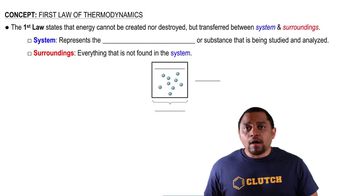
The First Law of Thermodynamics states that energy cannot be created or destroyed.
Which concept does the First Law of Thermodynamics describe?
The First Law of Thermodynamics describes the conservation of energy, meaning energy is transferred between a system and its surroundings but is never created or destroyed.
Which of the following defines the First Law of Thermodynamics?
The First Law of Thermodynamics is defined as: Energy cannot be created or destroyed, only transferred between a system and its surroundings.
The heat added to a thermodynamic system minus the work done is equal to which of the following?
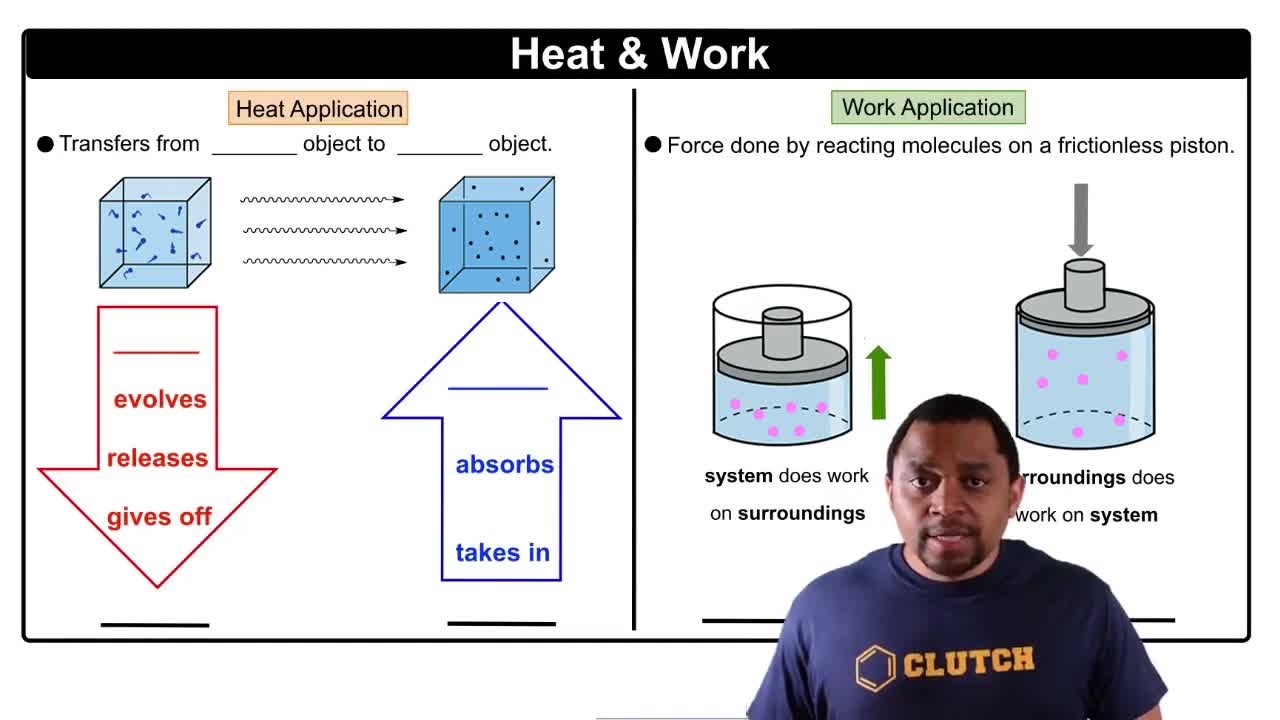
The heat added to a system minus the work done by the system equals the change in the system's internal energy (ΔE = Q - W).
Which of the following is a valid representation of the First Law of Thermodynamics?
A valid representation is: ΔE = Q - W, where ΔE is the change in internal energy, Q is heat, and W is work.
The First Law of Thermodynamics states that
Energy cannot be created or destroyed; it can only be transferred between a system and its surroundings.
What are the expected signs of ΔEsys and ΔEsurr when a system gains heat and does work on the surroundings?
ΔEsys (system's energy change) is positive if the system gains heat, but negative if it does work on the surroundings. ΔEsurr (surroundings' energy change) will be negative if the surroundings lose heat and positive if they gain energy from work done by the system.
In the context of thermodynamics, how do you distinguish between the system and the surroundings when studying a chemical reaction?
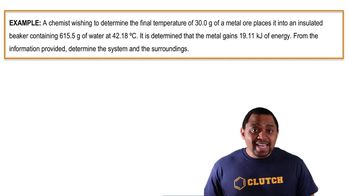
The system refers to the chemical reaction or substance being studied, while the surroundings include everything else, such as the container and the external environment.